Everyone wants a deal on real estate, and distressed properties seem like an easy shortcut. But buying a foreclosure in Charlotte isn’t a single process—it is four completely different transaction types depending on when you step into the pipeline. You can negotiate directly with an owner before the sale, bid on the courthouse steps, wait for a bank to repossess and list the home, or navigate Mecklenburg County’s separate tax foreclosure track.
Having managed investment properties in Charlotte since 2013, I see investors make the same fundamental mistake: they fall in love with the advertised discount, without accounting for the other debts that can be tied to the property.
The auction price is just a starting point. What determines your return is what you have tied up in the home after clearing surviving liens, fixing unseen structural defects, paying high-interest hard money, wrestling for legal possession, and possibly absorbing months of vacant holding costs.
Here is how each channel works in Mecklenburg County.
What are the ways to buy a foreclosure in North Carolina?
Pre-foreclosure offers the most transparency and control, while bank-owned (REO) homes mirror standard, financeable real estate deals. Courthouse auctions and tax sales yield bigger entry discounts, but you pay for that price gap with high operational risk and zero property access (most of the time).
| Purchase Route | Who You Buy From | Inspection? | Financing? | Main Risk |
|---|---|---|---|---|
| Pre-foreclosure | Property owner | Usually | Usually | Securing seller agreement before the auction deadline |
| Foreclosure Auction | Trustee (courthouse) | No | No (Certified funds) | Title defects, property condition, upset bids, forced eviction |
| Bank-Owned (REO) | Lender | Usually | Usually | Compression on profit margin / smaller discount |
| Mecklenburg Tax Sale | County / Outside Counsel | No | No (Certified funds) | Unclear title, hidden liens, unseen interior damage |
How many foreclosures are happening in Charlotte right now?
Mecklenburg County recorded 1,182 foreclosure filings in 2025—a 36.2% jump from 2024 and the highest volume of any county in North Carolina. Wake County followed with 975, and Guilford had 813.
Context matters before interpreting those figures as a market collapse.
| Year | Mecklenburg County Filings | North Carolina Filings | Meck vs. Prior Year |
|---|---|---|---|
| 2019 | 2,187 | 19,904 | — |
| 2020 | 915 | 8,302 | −58.2% |
| 2021 | 725 | 5,439 | −20.8% |
| 2022 | 1,174 | 11,672 | +61.9% |
| 2023 | 1,282 | 12,415 | +9.2% |
| 2024 | 868 | 10,816 | −32.3% |
| 2025 | 1,182 | 13,245 | +36.2% |
Despite the recent uptick, Mecklenburg’s 2025 total sits at just 54% of its 2019 volume. Distress is returning to baseline, but Charlotte is far from a flood of inventory.
A foreclosure filing is not the same as a foreclosure sale.
A filing simply tracks the opening of a civil proceeding before the Clerk of Superior Court. Most filings never reach the courthouse steps — owners modify loans, sell traditionally, reinstate balances, or seek bankruptcy protection. Treat filing data as an early pipeline tracker, not a count of physical houses up for grabs. The Administrative Office of the Courts states its report “does not display the number of foreclosures granted.”
National statistics tell a similar story. ATTOM reported 227,548 U.S. foreclosure filings in the first half of 2026 (a 21% year-over-year increase). North Carolina posted 8,429 filings (+46.7%), equating to one in every 581 housing units against one in 632 nationally. While national bank repossessions rose 33% to 27,983, there is a significant lag before that becomes listed inventory in Charlotte.
How do you buy a pre-foreclosure home in Charlotte?
Pre-foreclosures happen directly between you and the homeowner before any trustee sale. That gives you time to inspect the structure, pull title records, run traditional purchase contracts, and secure standard financing.
Public notices are posted at the Mecklenburg County Courthouse and published in The Mecklenburg Times under NCGS 45-21.17. However, since every investor has access to the same court dockets, your success depends entirely on your direct outreach to the owner.
When you approach someone facing foreclosure, remember that they are drowning in aggressive, predatory mailers. They don’t pick up the phone for strange numbers, and they naturally default to defensiveness. I’ve found that coming in as a solutions-oriented local operator—explaining how a direct transaction can save their credit from a judgment while giving them time to relocate—is the only approach that builds real trust. If you lead with an insulting lowball offer, the door closes permanently.
How does a North Carolina foreclosure auction work?
Courthouse auctions operate under strict statutory rules without contingencies for financing, inspections, or property access. Per NCGS 45-21.23, sales occur between 10:00 a.m. and 4:00 p.m. on any day the clerk’s office is open for transactions; the place of sale itself is governed by NCGS 45-21.4. The person conducting the sale may also accept remote bids under NCGS 45-21.25A.
Winning on auction day does not guarantee you own the asset.
The upset bid mechanic is the single most misunderstood part of a North Carolina sale, and it has its own guide: the NC upset bid process and the 10-day clock.
Required Capital and Timelines
Initial Deposit: Per NCGS 45-21.10(b), where the deed of trust itself does not set the terms, the trustee may require the highest bidder to make an immediate cash deposit NOT TO EXCEED the greater of 5% of the winning bid or $750, in certified funds. It is a statutory ceiling, not a fixed requirement.
The Upset Bid Process: Per NCGS 45-21.27(a), any third party can overturn your winning bid within 10 days by raising the price by at least 5% (minimum $750) and filing a deposit of at least 5% of the upset bid, but in no event less than $750, with the Clerk of Superior Court. Each valid upset bid resets that 10-day clock completely.
A $200,000 winning bid requires $10,000 cash on the spot, but an upset bid at $210,000 restarts the entire window. A North Carolina foreclosure auction isn’t a single event—it is an extended, open bidding process.
Managing Occupancy and Evictions
Winning an auction sometimes means receiving an occupied home. Under NCGS 45-21.29(k), you must petition the Clerk of Superior Court for an Order for Possession, giving occupants 10 days’ notice (or 30 days for properties with 15+ rental units).
Operational Reality: It’s a delicate dance dealing with homeowners occupying a property that has now gone to foreclosure and the sale is final. It is emotionally straining. Having to approach the former owners, explain you are the new owner and they will need to move out is tough. Then, securing an Order for Possession and executing a sheriff-assisted lockout poses more challenges. Empathy, grace, professionalism, and patience is a must have for these types of situations. For what that looks like when the occupants stop answering — and what North Carolina law does and doesn’t require you to disclose afterward — see what happens when someone is still living in a foreclosed property.
How do Mecklenburg County tax foreclosures work?
Tax foreclosures result from unpaid property taxes and are prosecuted through either mortgage-style (NCGS 105-374) or in rem (NCGS 105-375) judicial proceedings.
Unlike mortgage sales, tax properties are managed across four distinct entities:
Mecklenburg County Tax Collector: Houses the central portal, interactive mapping tools, and master legal filings.
The Kania Law Firm: Handles dedicated county listings, bid submission portals, and upset bid filings.
Ruff, Bond, Cobb, Wade & Bethune, L.L.P.: Manages a specific subset of tax sales and posts detailed procedural guides.
Office of the County Attorney: Directs internal in rem tax foreclosures handled in-house.
Tax Bidding Rules
Tax sales follow the same 10-day, 5% upset bid rules as mortgage auctions. Upset bids must be submitted in person at the Mecklenburg County Clerk’s counter. You have no legal right to step foot inside prior to closing, and existing federal tax liens can restrict immediate resale options. You are buying completely sight-unseen.
Where can you find foreclosure homes in Charlotte?
| Source | What It Covers | Target Acquisition Path |
|---|---|---|
| tax.mecknc.gov | Tax delinquency maps and sale schedules | Tax Foreclosure |
| Kania Law Firm / Ruff Bond | Active tax sale dockets and bid guidelines | Tax Foreclosure |
| Mecklenburg Times | Published legal notices for pending sales | Pre-Foreclosure & Auction |
| Clerk of Superior Court | Open dockets, upset bid filings, possession orders | Auction & Tax Sales |
| Local MLS Portals | Fully repossessed, bank-owned real estate | Bank-Owned (REO) |
Investors rely on early public filings to beat retail competition, while standard buyers typically stick to MLS REO inventory.
If you are searching for bank owned homes in Charlotte, that last row is your lane — REO inventory reaches the MLS like any other listing. A Charlotte real estate auction, by contrast, never appears there at all.
What is a bank-owned or REO foreclosure?
If the sale produces no qualifying third-party bid, ownership reverts to the lender as Real Estate Owned (REO). The bank then clears junior liens, manages occupant removals, and lists the property through a local real estate broker.
REO deals offer clear titles, structural inspection access, and standard financing options. However, because the bank absorbs the upfront legal and holding costs, REO properties command higher prices and deliver tighter profit margins.
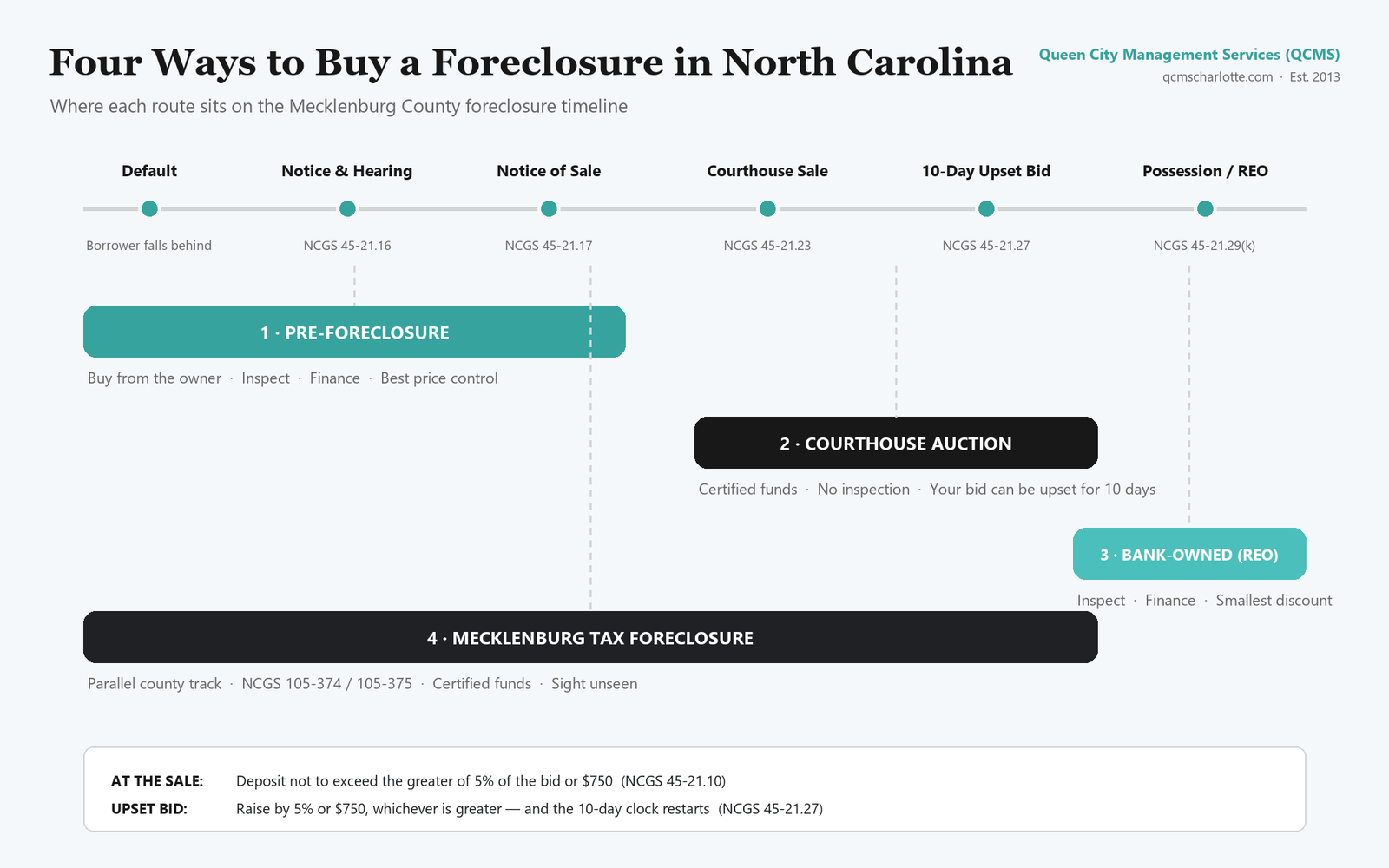
What does the North Carolina foreclosure process look like?
| Stage | Operational Event | Governing Statute | Acquisition Opportunity |
|---|---|---|---|
| Default | Borrower falls behind; file moves to trustee | — | Early direct pre-foreclosure outreach |
| Notice & Hearing | Case opened before the Clerk | NCGS 45-21.16 | Title research & deal structuring |
| Notice of Sale | Public posting at courthouse & media | NCGS 45-21.16A, 45-21.17 | Final pre-auction negotiation window |
| Courthouse Sale | Public bidding on steps / online | NCGS 45-21.10, 45-21.23 | Auction acquisition |
| Upset Bid Window | Rolling 10-day period for higher bids | NCGS 45-21.27 | Active secondary bidding |
| Possession | Buyer petitions for occupant removal | NCGS 45-21.29(k) | Holding phase & initial planning |
| REO Transition | Bank takes title after failed auction | — | Traditional MLS purchase |
Can you finance a foreclosure in North Carolina?
Pre-foreclosure purchases and REO listings support standard mortgage products. Conversely, courthouse auctions and tax sales require liquid funds—cash, private capital, or revolving lines of credit.
If you use high-cost private money to win an auction, factor in the extended timeline. Paying private-money rates while you navigate an occupancy dispute and then a multi-month rehab will erase an auction discount faster than most investors model it.
What are the biggest risks of buying a foreclosure?
| Risk | What it costs you | How to check it before you bid |
|---|---|---|
| Surviving liens | Foreclosure deeds do not automatically wipe out every encumbrance | Conduct detailed title searches to catch senior mortgages, tax judgments, or municipal liens |
| Property condition | Sight-unseen purchases hide foundation failures, stripped wiring, or severe mold | Always build a substantial contingency cushion into your maximum bid |
| Occupancy and eviction | Removing previous owners or non-paying tenants takes time and legal expense | Model holding costs from the date of the sale, not the date you expect to get the keys |
| Upset bid risk | Locking in a high bid on sale day does not guarantee you won the property | Never tie up your entire capital base while an upset window remains open |
Which liens survive depends on where the foreclosing lien sits in the stack. We break that down in the NC foreclosure lien hierarchy, and separately for HOA foreclosures, which behave differently.
Is buying a foreclosure a good investment in Charlotte?
It depends entirely on your net acquisition cost. UNC Charlotte’s Childress Klein Center for Real Estate reported a regional median home price of $443,850 in its State of Housing in Charlotte 2025 report, estimated the household income needed to afford it at $146,280, and found that 1.88% of market sales fall below $150,000. In a competitive market like this, off-market channels are worth learning.
Operational Reality: When we evaluate properties at auction, we automatically add in an additional 3-6 months on the timeline after the closing. As investors, you need to think about your renovation crew (availability, timeline, capacity, permits, etc). Sometimes, you think an acquisition is going to be light rehab (“lipstick on a pig” deal) until you really dig in and realize you have a bigger problem. Sometimes a flip has to turn into a buy and hold, to make the ROI numbers balance out pending unexpected challenges.
Frequently Asked Questions
How do you buy a foreclosure in North Carolina?
You can acquire properties before the sale via pre-foreclosure direct sales, place cash bids through the clerk’s foreclosure sale, purchase REO homes off the MLS, or bid on tax sales through Mecklenburg County’s designated law firms.
What is the difference between pre-foreclosure, auction, and REO?
Pre-foreclosure involves negotiating directly with the owner. Auction buying happens on the courthouse steps without contingencies or inspections. REO properties are bank-owned homes re-listed on the open market after a sale produces no qualifying third-party bid.
Where do you find foreclosure homes in Charlotte?
Track legal notices in The Mecklenburg Times, search tax sale listings via tax.mecknc.gov, audit filings at the Mecklenburg County Clerk’s office, or monitor local MLS portals for bank-owned inventory.
How much cash do you need at a North Carolina foreclosure auction?
Under NCGS 45-21.10, where the deed of trust does not set its own terms, the trustee may require an immediate cash deposit not to exceed the greater of 5% of the winning bid or $750, with the balance due upon closing.
How long is the North Carolina upset bid period?
The upset bid window lasts 10 days from the filing of the sale report. Any qualifying higher bid (minimum 5% increase or $750) resets the 10-day period.
Can you finance a foreclosure in North Carolina?
Yes, for pre-foreclosure sales and bank-owned REO properties. Courthouse auctions and tax foreclosure sales require liquid funds or non-contingent private financing.
Can someone still be living in a foreclosure after I buy it?
Yes. You must petition the court for an Order for Possession, granting occupants a mandatory 10-day notice period (or 30 days for large rental complexes) before physical removal.
Are foreclosure auctions risky?
Yes—they feature sight-unseen physical risks, potential surviving liens, legal delays around occupancy, and the possibility of being outbid during the 10-day upset bid period.
The Bottom Line
There is no shortcutting the foreclosure process in Charlotte.
If you require financing and detailed property inspections, stick to pre-foreclosure negotiations or bank-owned REO listings. If you plan to bid on the courthouse steps or enter Mecklenburg County tax sales, complete your title work in advance, secure your cash upfront, and build a deep financial buffer for unseen repairs and holding delays.
Know what liens survive, understand your total holding costs, and establish your walk-away price before bidding begins.
Queen City Management Services (QCMS) has managed rental portfolios in Charlotte since 2013. If you are analyzing a local investment property, evaluating potential rental yields, or requiring professional management, contact us at 704-941-4557.
More on how we work with investors and landlords: Charlotte property management services for investors and landlords.
Disclaimer: This guide provides general informational coverage of North Carolina foreclosure procedures and does not constitute legal or financial advice. Consult a qualified NC attorney regarding specific property titles and legal proceedings.
Sources
North Carolina Administrative Office of the Courts — “Foreclosure Filings,” county-level and statewide counts by calendar year, 2025 edition. Mecklenburg County: 2,187 (2019), 915 (2020), 725 (2021), 1,174 (2022), 1,282 (2023), 868 (2024), 1,182 (2025). North Carolina statewide: 13,245 (2025), 10,816 (2024). The report counts civil cases with a foreclosure hearing and notes it “does not display the number of foreclosures granted.” nccourts.gov/documents/publications/foreclosure-filings
ATTOM — “Mid-Year 2026 U.S. Foreclosure Market Report,” July 16, 2026. 227,548 U.S. properties with foreclosure filings in H1 2026, up 21% year over year; national rate one in every 632 housing units; foreclosure starts 164,566, up 18%; REO/bank repossessions 27,983, up 33%. North Carolina: 8,429 filings, up 46.72%, one in every 581 housing units. attomdata.com
North Carolina General Statutes, Chapter 45, Article 2A — power-of-sale foreclosure. § 45-21.4 (place of sale) · § 45-21.10 (cash deposit at sale: not to exceed the greater of 5% or $750) · § 45-21.16 (notice and hearing) · § 45-21.16A (contents of notice of sale) · § 45-21.17 (posting and publishing notice of sale) · § 45-21.23 (sale held between 10:00 a.m. and 4:00 p.m. on a day the clerk’s office is open) · § 45-21.25A (bids placed remotely) · § 45-21.27 (upset bid: 5% minimum raise, $750 minimum, 10-day period) · § 45-21.29(k) (orders for possession; 10 days’ notice, 30 days where the property has 15 or more rental units). ncleg.gov
North Carolina General Statutes § 105-374 (mortgage-style tax foreclosure) and § 105-375 (in rem tax foreclosure). ncleg.gov
Mecklenburg County Office of the Tax Administration — “Tax Foreclosure Properties.” Sales under NCGS 105-374 or 105-375; listings maintained by The Kania Law Firm and Ruff, Bond, Cobb, Wade & Bethune, with in rem foreclosures handled by the Office of the County Attorney; 10-day upset bid period requiring a raise of 5% of the last bid or $750, whichever is greater, and a deposit of 5% of the new bid or $750, whichever is greater. tax.mecknc.gov/tax-foreclosure-properties
The Kania Law Firm — “Foreclosure Listings, Mecklenburg County, NC,” bidder advisory. Upset bids must be filed in person during the Mecklenburg County Clerk of Superior Court’s public counter hours; bidders have no legal right to enter the property before bidding; resale immediately after the sale may be restricted where a federal tax lien is present. kanialawfirm.com
Ruff, Bond, Cobb, Wade & Bethune, L.L.P. — “Tax Foreclosure Process.” Mecklenburg County tax listing date January 1; rate set by July 1; bills mailed August to September; taxes delinquent after January 5 and then subject to foreclosure. rbcwb.com/tax-foreclosure-process
Childress Klein Center for Real Estate, Belk College of Business, UNC Charlotte — “State of Housing in Charlotte 2025,” released October 29, 2025. Regional median home price $443,850; household income required $146,280; 1.88% of homes sold under $150,000. belkcollege.charlotte.edu
Queen City Management Services (QCMS) — Charlotte investment property and foreclosure evaluation experience, 2013 to 2026. First-party operating records.
About the Author
Halah Kablan Ladson is Broker-In-Charge of Queen City Management Services (QCMS) in Charlotte, North Carolina. She has worked in real estate for 22 years across four states and has operated QCMS since 2013. NC License No. 272964 · SC License No. 107533 · NC Firm No. C24768 · Est. 2013. Connect with Halah on LinkedIn.
Last updated: September 2026