
By Halah Kablan Ladson · Broker-In-Charge · Licensed NC & SC · NC License No. 272964 · NC Firm No. C24768 · Est. 2013 · Last updated: September 2026
Many of my investor clients and friends love HOA foreclosures. The barrier to entry is low: sometimes only a few thousand dollars to start. The opening number is just unpaid dues, not a full mortgage balance — and the field is thin, because most bidders don’t understand the strategy of how to bid on HOA foreclosures. The actual paperwork process is the same, so that’s not what we are talking about. It’s the exit strategy once you win the bid — because that is the whole goal of attending the auction in the first place. Property acquisition. That’s the opportunity.
So once you win the bid, what happens? If you read my previous article on lien hierarchy in NC, you know this: in North Carolina, the senior liens survive an HOA foreclosure. The first mortgage doesn’t disappear because I won the auction. Neither does a second mortgage, a tax lien, an IRS or state lien, or a docketed judgment recorded ahead of the HOA. If I bid without factoring all of those pieces into my strategy, that “cheap” house does not stay cheap at all.
North Carolina HOA foreclosure at a glance
| Question | Answer |
|---|---|
| HOA super-lien in NC? | No — the HOA lien is subordinate to a prior-recorded mortgage and to property taxes (§ 47F-3-116) |
| Lien attaches | Once an assessment is 30+ days delinquent (15-day written notice before recording) |
| Foreclosure can start | Assessment unpaid 90+ days AND the executive board votes to proceed |
| Method | Nonjudicial power-of-sale for assessments; fines-only debt = judicial foreclosure only |
| Minimum balance to foreclose | None — NC sets no dollar or months-of-assessments threshold (90+ days past due + board vote) |
| What survives the sale | Senior liens recorded before the HOA’s claim — 1st/2nd mortgages, taxes, IRS/state liens, judgments |
| After you win | Ownership — not clean title. The real work begins. |
How often do North Carolina HOAs actually foreclose?
Less often than the demand letters suggest — but far from rare, and it is concentrated in my backyard. A Charlotte Observer and News & Observer investigation of state court records found that HOAs in North Carolina foreclosed more than 5,500 times since 2018, and nearly half of those filings were in Mecklenburg County (WFAE, 2023). So this isn’t a fringe event in Charlotte; it’s a recurring source of courthouse inventory.
Nationally, HOAs filed roughly 284,933 assessment liens in 2025, up 8.6% year over year (National Mortgage News / HousingWire, 2025) — orders of magnitude more liens than foreclosures, because most delinquencies get paid once a lien or the threat of a sale lands. For me as a bidder, that gap is the point: the foreclosures that do reach the courthouse are a small, self-selected slice, and fewer competitors show up for them than for mortgage or tax sales. Thin fields are where disciplined bidding wins.
Where does the HOA lien rank in North Carolina?
North Carolina is not a super-lien state. Under N.C. Gen. Stat. § 47F-3-116 (the Planned Community Act; § 47C-3-116 for condominiums), the HOA’s assessment lien is prior to everything on the lot except two things: (1) any mortgage or deed of trust recorded before the HOA docketed its claim of lien, and (2) real estate taxes and government charges. Those two exceptions are exactly the ones that can bury a bidder.
Because the HOA lien is junior, the order of foreclosure decides what a bidder inherits:
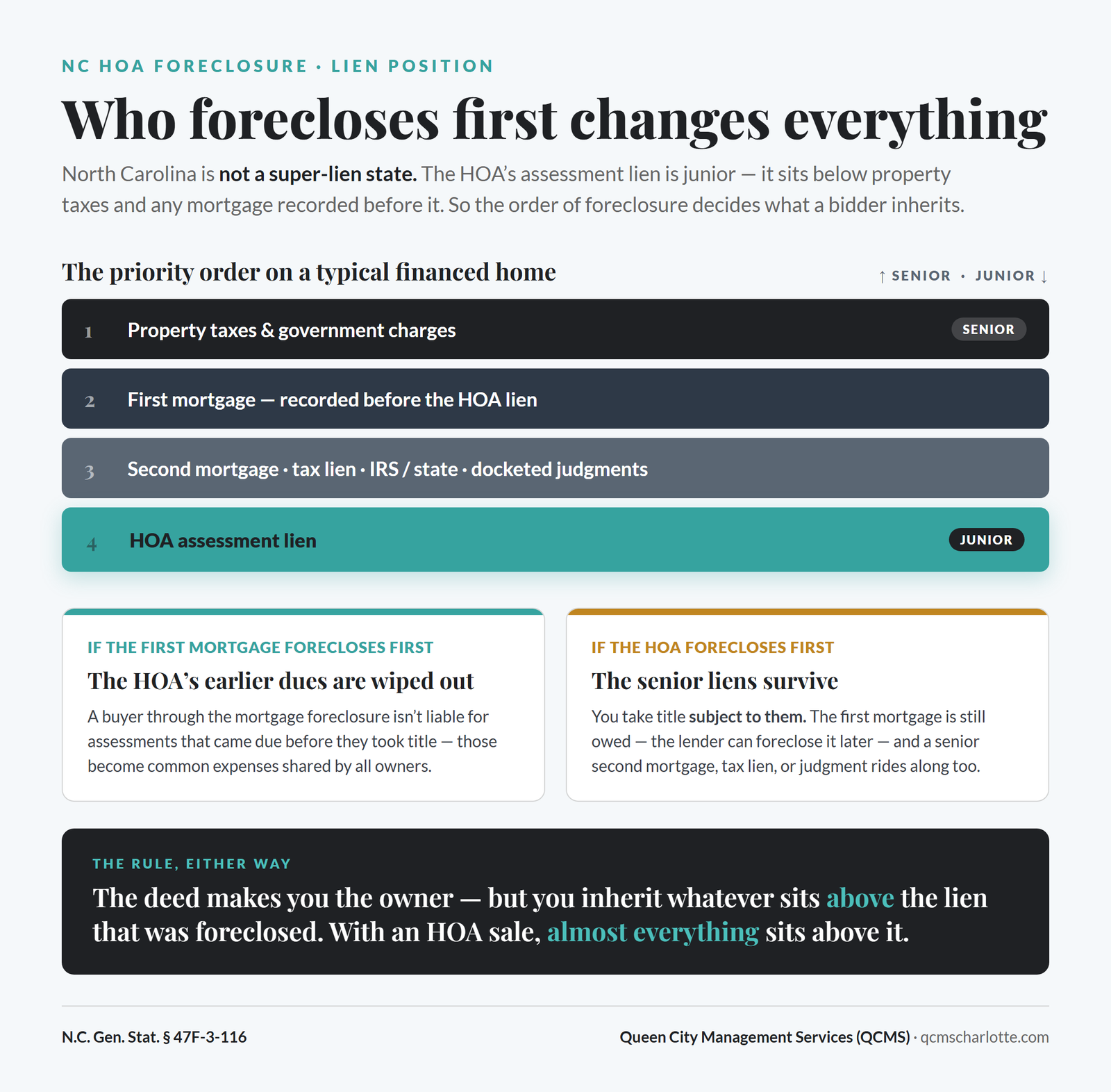
If the first mortgage forecloses first, the HOA’s earlier assessments are generally wiped out — a buyer through the mortgage foreclosure isn’t liable for dues that came due before they took title (§ 47F-3-116). If the HOA forecloses first, the senior liens do not get wiped out: you take title subject to them, the first mortgage is still owed, and the lender can foreclose it later. Either way, the deed makes you the owner, but you inherit whatever sits above the lien that was foreclosed — and with an HOA sale, almost everything sits above it.
You won the bid — now what about the surviving mortgage? Who pays it, and can you lose the house you just bought?
This question opens a slew of scenarios. Understanding what happens NOW, after you won the bid, determines which direction you go with the property. When I’ve bought at an HOA foreclosure and a first mortgage is still on the property, I keep two things straight: the note and the deed of trust. A mortgage is really both — a note (the former owner’s personal promise to repay the debt) and a deed of trust (a lien on the property itself). The HOA sale changes who owns the property. It changes nothing about either half of that mortgage — the financial obligation that now clouds the title. (I go into detail on this in my lien hierarchy article.)
Scenario 1: The former owner stops paying the mortgage — and they usually do, since they no longer own the house. Now the bank can foreclose its surviving deed of trust on the property. It can’t pursue you personally — you never signed the note — but the house is the collateral, so unless you reinstate or pay off that loan, you can lose the property you just won.
Scenario 2: The former owner buys back or reimburses you for your position as the new owner. They want to keep the house and stay in it, and now want to work something out with you — whether that’s what you paid at auction or a price you negotiate together.
Scenario 3: You make arrangements with the former owners and keep making payments on the mortgage(s). This is a “Subject-To” structure, common among investors: the former owners give you the lender information (account number, mailing address, amount) and YOU make the payments. Note that this is an unsanctioned loan assumption, and almost all lenders have a Due-on-Sale clause in the deed of trust to prohibit it — yet it is still very common.
| What the bank pursues | How | Can it reach you, the auction buyer? |
|---|---|---|
| The property | The deed of trust — the lien that survived the HOA sale | Yes. Your title is junior, so the lender can foreclose it and you can lose the house you just bought. |
| The former owner | The promissory note — personal liability of whoever signed the loan | No. You never signed the note, so you’re not personally liable — subject to NC anti-deficiency limits (§ 45-21.38). |
Here’s the part that trips up bidders: I am not on that note. I didn’t sign it, so the bank can’t come after me personally for the mortgage debt. But it doesn’t have to — it has my house as collateral. To keep the property, I have to make the mortgage current or pay it off. If I don’t, the bank forecloses and I lose the property I just won at auction. Practically, winning an HOA auction on a home with a live first mortgage means I’ve either budgeted to buy out or reinstate that loan, or I’m gambling the house away.
Do lenders bid at these HOA auctions? In North Carolina, usually they don’t need to. Because NC is not a super-lien state, the first mortgage survives the HOA sale automatically — the lender’s position is already protected, so it can foreclose its own deed of trust later if payments stop, or advance the unpaid HOA dues to stop the sale and avoid a third-party owner cluttering the title. (In super-lien states, where an HOA lien can wipe out the mortgage, servicers are far more aggressive.) So at a North Carolina HOA auction I’m usually bidding against other investors, not the bank — but the bank’s silent, surviving lien is the biggest number in the room.
How does an HOA foreclosure reach the courthouse steps in NC?
Before a property ever shows up on the auction calendar, the association has to earn the right to sell it. In North Carolina an HOA forecloses by power of sale — the same machinery as a deed of trust — and that route requires a pre-foreclosure hearing before the Clerk of Superior Court (§ 45-21.16). At that hearing the clerk must find four things before authorizing a sale: a valid debt the association actually holds, an actual default, the right to foreclose under the recorded declaration, and proper notice to everyone entitled to it. It is not an overnight administrative filing, and it is where a sloppy association, a disputed balance, or a fines-only claim gets stopped. For me as a bidder, that hearing is useful information: by the time a property clears it and reaches the steps, the debt and the default have already been vetted by the court.
How should an investor build a bid at an HOA foreclosure auction?
HOA auction prices are low — extremely low, when you think about property acquisition. A few thousand dollars and it looks like you can get ownership of a two-story, three-bed, two-bath home in a decent neighborhood (they have an HOA). The low entry price is the bait; the surviving debt is the hook. Navigating those strings is where the profit lies. Here is the breakdown:
- Pull a full title search first. I map every lien senior to the HOA — first and second mortgages, property-tax arrears, IRS and NC Department of Revenue liens, and docketed judgments — with their recording dates relative to the HOA’s claim of lien. Those dates decide what survives.
- Price the senior debt into the bid. A “$4,000” HOA auction on a home carrying a $210,000 first mortgage is not a $4,000 house. My real basis is the winning bid plus whatever it costs to satisfy or negotiate down the surviving senior liens to reach a marketable, insurable title.
- Confirm it’s an assessment foreclosure, not fines-only. In North Carolina, a lien made up solely of fines, interest on fines, or fine-related attorneys’ fees can’t be foreclosed by power of sale — only by judicial foreclosure. A nonjudicial HOA sale should be backed by unpaid assessments.
- Respect the upset-bid window. During those ten days anyone can outbid me, and the owner can still pay the debt and stop the sale entirely.
Remember: winning the auction is ownership, not clean title. Cleaning the title is where the work — and the expertise — comes into play.
What happens after you win — the part nobody plans for
The auction is the easy part. Turning that deed into a property I can actually sell or rent is where HOA deals get real, and it runs on three fronts.
Cleaning the title
An HOA sale gives me ownership, not marketable, insurable title. Auction properties are typically cash purchases. To sell or refinance later, I have to resolve the surviving senior liens — pay them, negotiate a payoff or release, or in some cases quiet the title. I budget the time and cost of that from day one, because a title company won’t insure around a live first mortgage in someone else’s name.
The former owner may not accept that they lost the home
This is the human part, and by far the most challenging part of being an investor. We hunt for deals — to flip, to buy and hold, maybe to live in. It’s a numbers game to us. But there are real people behind the auctions, the abandoned houses, and the dirty titles, and a lot of the time it’s a delicate dance. A lot of these owners lost the property over what started as a few hundred dollars in dues, and many don’t fully register that a sale actually happened — or don’t accept it.
My first move is direct, respectful contact: confirm the sale is final, explain the timeline, and talk about options (a move-out window, sometimes cash-for-keys) before anything adversarial. Handled well, most of these resolve without a fight. Handled badly, they become the eviction below — slower, costlier, and worse for everyone.
Removing occupants: the writ of possession
Sometimes the former owner or other occupants decide not to leave. North Carolina has a defined process if it comes to that. Once the sale is final and the deed is recorded, I ask the Clerk of Superior Court for a writ of possession, and we go through a removal process much like a non-paying tenant on a rental. The occupants get a 10-day notice to vacate; if they haven’t left, the sheriff executes the writ, removes them and their belongings, and puts me in possession, with statutory notice and short windows for retrieving personal property (§ 45-21.29; Chapter 45, Article 2A; § 42-36.2). It’s orderly, but it takes weeks — factor it into the holding cost of every HOA deal.
What are your options if you’re a homeowner behind on HOA dues?
From the other side, the process gives you more room than a demand letter implies — but it is real and it moves on a schedule. A lien can attach once you’re 30+ days late (after a 15-day notice), but foreclosure can’t begin until you’re 90+ days delinquent and the board votes to proceed. North Carolina sets no minimum-dollar threshold — once you’re 90+ days delinquent and the board votes to proceed, the association can foreclose over the unpaid balance, which is how relatively small debts have led to full foreclosures across the state. Fines alone can’t trigger a power-of-sale foreclosure — and North Carolina caps most fines at $100 per day and requires a hearing opportunity first (§ 47F-3-107.1). Your options before a sale: pay, request a written payment plan, or dispute improper charges. And because a first mortgage survives an HOA sale, your lender may step in and pay the HOA to protect its position — one more reason most of these never reach a final auction.
In the end, this is a strategy for when you decide to bid on an HOA foreclosure. Just like every auction, there are risks. Understand your position, factor in all the details that come with the property, and have a plan for the direction you want to go. Wishing you all the best at the county courthouse.
Frequently asked questions
Does an HOA foreclosure wipe out the mortgage in North Carolina?
No. North Carolina has no HOA super-lien, so a first mortgage recorded before the HOA’s claim of lien survives the HOA foreclosure. The buyer takes the property subject to that mortgage (§ 47F-3-116).
Is buying at an HOA foreclosure auction cheaper?
The entry price is lower — the opening bid is unpaid dues, not a mortgage balance — but it isn’t necessarily a better deal. The senior liens survive, so the true cost is the bid plus clearing whatever debt sits above the HOA lien.
How do I remove the former owner after winning an HOA foreclosure in NC?
After the sale is final and the deed is recorded, get a writ of possession from the Clerk of Superior Court. Occupants receive a 10-day notice; if they don’t leave, the sheriff removes them and puts you in possession (§ 45-21.29).
Can I lose a house I bought at an HOA foreclosure auction?
Yes. Your title is junior to any surviving mortgage. If the loan isn’t paid, the lender can foreclose its deed of trust and sell the house again, and you can lose it. You aren’t personally liable on the mortgage note (you didn’t sign it), but the property is the collateral — so to keep it you must reinstate or pay off the mortgage.
If the former owner stops paying the mortgage after an HOA foreclosure, who does the bank pursue?
Both, differently. The bank forecloses the property through the deed of trust (which survived), and it pursues the former owner personally on the note — subject to North Carolina’s anti-deficiency limits, including the purchase-money bar in § 45-21.38.
How much do you have to owe before an HOA can foreclose in NC?
There is no minimum-dollar threshold in North Carolina. Once the assessment is 90+ days delinquent and the executive board votes to proceed, the association can foreclose — which is how relatively small unpaid balances have led to full foreclosures in the state.
Disclaimer: This article is written from the point of view of an active real estate investor and broker, not a real estate attorney, and is for informational purposes only — not legal advice. Foreclosure and lien outcomes turn on the specific facts of each property. Pull a full title report and consult a licensed North Carolina attorney before bidding.
References & Legal Authority
- N.C. Gen. Stat. § 47F-3-116 — HOA assessment lien priority (Planned Community Act)
- § 47C-3-116 — condominium assessment lien (Condominium Act)
- § 47F-3-107.1 — HOA fines and hearing requirement
- § 45-21.16 — power-of-sale pre-foreclosure hearing
- § 45-21.27 — upset bids (10-day period)
- § 45-21.29 — possession after sale; writ of possession
- § 45-21.38 — purchase-money anti-deficiency
- § 42-36.2 — notice and personal-property handling on execution
- Charlotte Observer / News & Observer investigation (WFAE, 2023) — 5,500+ NC HOA foreclosures since 2018, ~half in Mecklenburg County
- National Mortgage News / HousingWire (2025) — HOA assessment-lien filing data
About the Author
Halah Kablan Ladson is Broker-In-Charge of Queen City Management Services (QCMS) in Charlotte, North Carolina. She has worked in real estate for 22 years across four states and has operated QCMS since 2013. NC License No. 272964 · SC License No. 107533 · NC Firm No. C24768 · Est. 2013. Connect with Halah on LinkedIn.
Last updated: September 2026
One Response