
By Halah Kablan Ladson — Broker-In-Charge — Licensed NC & SC — NC License No. 272964 — NC Firm No. C24768 — Est. 2013
This article references lien hierarchy for the state of North Carolina only. Each state is different and subject to different statutes. As good practice, always review a full title report and consult a real estate attorney or title abstractor in your state before bidding.
This article is written from our first-hand experience as real estate investors — actual auction attendance, upset bids placed, final bids awarded and closed. We are not attorneys or title abstractors; this is informational purposes only, from an investor’s point of view.
Scope: This article covers mortgage (deed of trust) foreclosure auctions under Chapter 45 — the most common sale at the courthouse. Property tax foreclosure sales work differently — in some ways backwards — and are covered in their own section below. South Carolina’s redemption-based tax-sale system will be covered in a future article.
What is the summary of North Carolina foreclosure lien priorities?
Answer: North Carolina foreclosure lien priority is dictated primarily by recording date under the state’s pure race statute, with specific statutory exceptions. Local property taxes hold super-priority over all claims. Mechanics’ liens can relate back to the first date labor or materials were furnished. A first deed of trust sits above junior mortgages, docketed judgments, docketed state (NCDOR) tax liens, and HOA assessment liens — each of which takes its place in line by its own recording or docketing date.
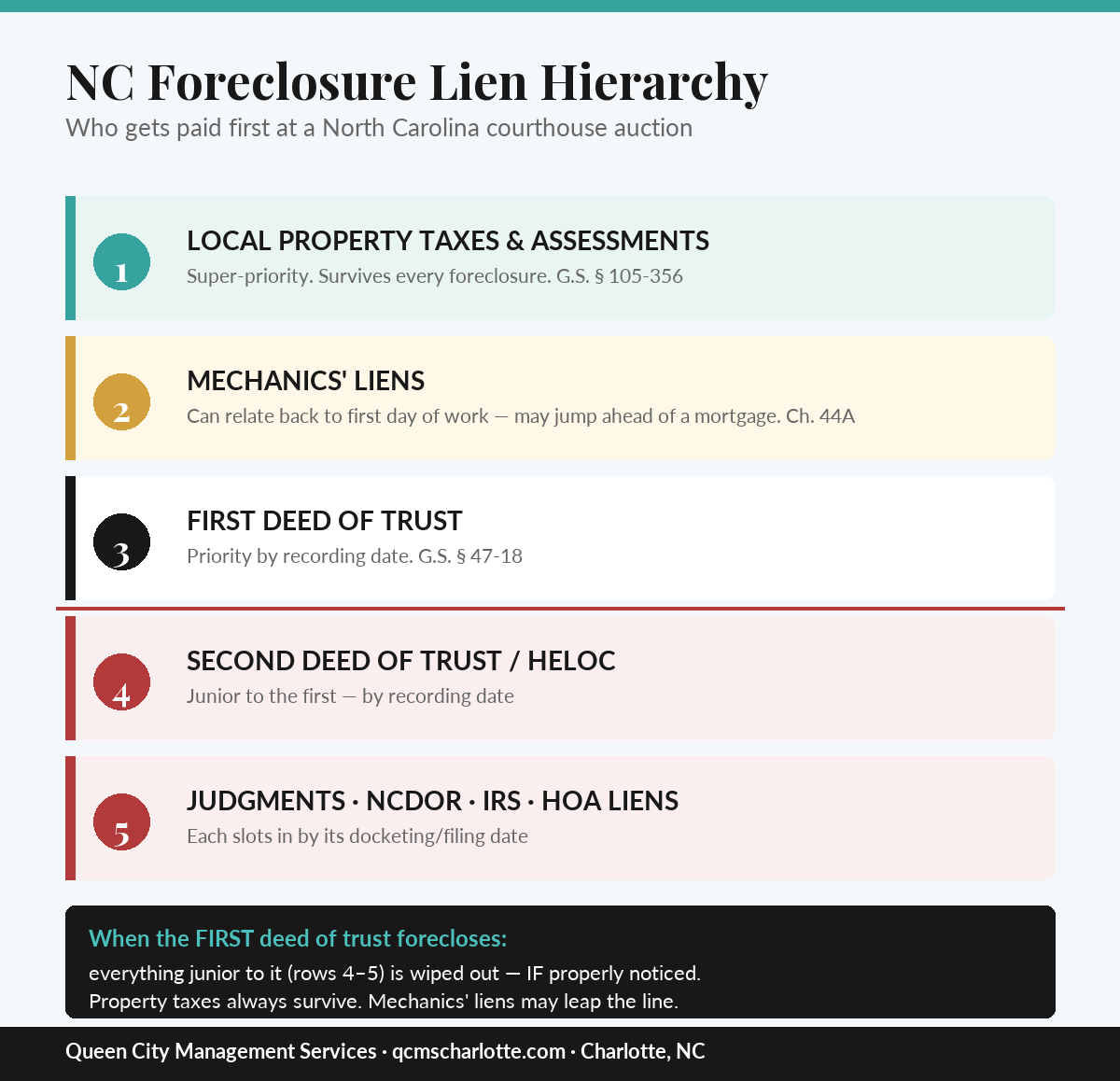
| Priority | Lien | Status when the first deed of trust forecloses |
|---|---|---|
| 1 | Local property taxes & assessments | Always survives — super-priority (G.S. § 105-356) |
| 2 | Mechanics’ liens | May relate back ahead of a mortgage (Chapter 44A) |
| 3 | First deed of trust | The senior mortgage; priority by recording date |
| 4 | Second deed of trust / HELOC | Wiped out if properly noticed |
| 5 | Judgments · NCDOR · IRS · HOA liens | Wiped if properly noticed (IRS keeps a 120-day redemption right) |
As investors, we are always hunting for good deals, and courthouse auctions naturally play a huge role in that strategy. But bidding on the courthouse steps is a minefield if you don’t understand titles, judgments, liens, and North Carolina statutes. We usually assume lien hierarchy is a conversation reserved for title abstractors and real estate attorneys — but understanding lien priority is vital to your acquisition strategy. If you want title insurance and marketable, sellable title down the road, this is the conversation to have before you raise your hand.
What is the difference between a deed and a title at a North Carolina foreclosure auction?
Answer: At a North Carolina foreclosure auction, a deed is the legal document that transfers ownership, while title is the underlying condition of that ownership — the full bundle of rights, claims, and encumbrances attached to the land. Winning an auction awards you the deed, but any surviving liens or encumbrances remain attached to the title and transfer directly to you.
The deed is your proof of ownership. Win at auction and close, and the deed makes you the owner — you can occupy the property, rent it, even resell it. The title is the condition that ownership is in. A cloudy title still transfers to you; the clouds simply ride along with the deed.
We’ve all heard “free and clear title,” but understanding the deed/title relationship gives it a deeper meaning: ownership with nothing attached — no loans, no judgments, no carryovers. Yours, undisputed, which gives you the option to leverage it how you want: borrow against it, pledge it, use it to buy the next asset. The moment you do, a financial obligation attaches to the title and deed — ownership stays yours, but now you owe someone, and the record says so.
We know this first-hand: we bought the deed to a property in foreclosure with three liens riding on it. We owned it from day one — but we had to satisfy those liens before we had full control of the equity and could leverage any financial gain. We bought ownership with a cloudy title, and clearing it is where the work (and the financial payoff) was.
Why should auction bidders pull the Special Proceeding (SP) court file?
Answer: Bidders must review the Special Proceeding (SP) court file at the county courthouse because it contains the exact Book and Page of the foreclosing deed of trust, proof of service, and notice documentation. Reviewing the SP file verifies whether you are bidding on a first or junior position and flags unnoticed lienholders. If a junior lienholder was not properly noticed under N.C.G.S. § 45-21.16, their lien survives the sale — and that procedural error is where future title nightmares are born.
“The best thing you can do before bidding at auction is go to the courthouse and pull the court file. There is so much information in there that most bidders never open. Often a full title report is right inside the file, dated, so you know the last time it was researched. It shows existing liens and payoff amounts — information that directly shapes your bidding strategy.”
— Halah Kablan Ladson, Broker-in-Charge, Queen City Management Services
What happens to junior liens when a first mortgage forecloses in NC?
Answer: When a first deed of trust forecloses under N.C.G.S. Chapter 45, all properly noticed junior liens — including second mortgages, docketed civil judgments, and HOA assessment liens — are extinguished against the real property. Senior liens, unpaid property taxes, and any junior lien whose holder was not properly noticed survive the sale entirely.
North Carolina forecloses deeds of trust through a power-of-sale special proceeding heard by the Clerk of Court. Junior claimants don’t vanish — they get paid in priority order out of any surplus above the first’s payoff — but their claim against the land is cut off, and the purchaser takes title clear of them. What the first-mortgage sale does not clear: property taxes (they always survive), any lien senior to the foreclosed deed of trust, and — critically — any junior lienholder who was not properly noticed in the proceeding. That last category is where title problems are born, and it’s why the SP file matters more than the auction flyer.
What are you actually buying at a second-mortgage or HOA foreclosure?
Answer: You take the property subject to every senior lien — you are buying an equity position, not a clean house. A foreclosure can only wipe out liens junior to the one being foreclosed, so foreclose the second and the first survives in full. If you don’t pay off or service that surviving first mortgage, the first lender can foreclose under Chapter 45 and wipe you out.
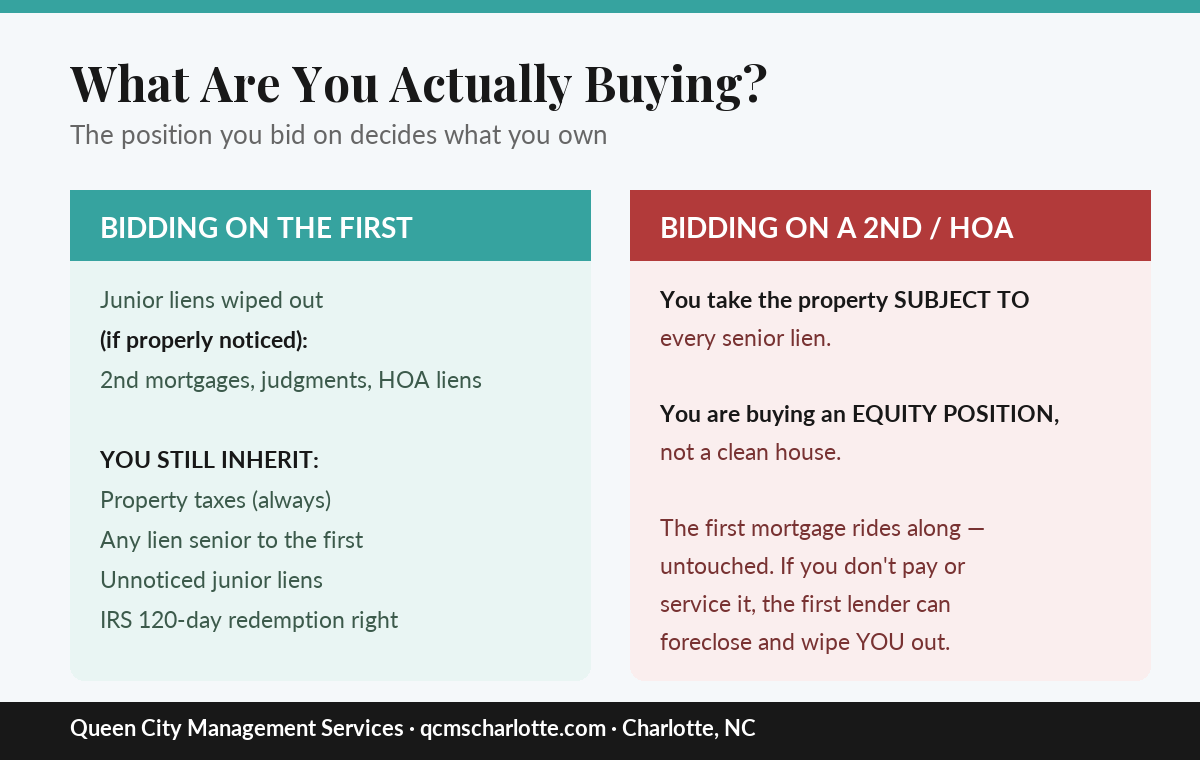
| Bidding on the FIRST | Bidding on a 2nd / HOA | |
|---|---|---|
| Junior liens | Wiped out (if properly noticed) | You are the junior buyer |
| Senior liens | You inherit any lien senior to the first | You take subject to ALL senior liens |
| What you own | Relatively clean title (minus taxes, unnoticed juniors, IRS redemption) | An equity position, not a clean house |
| Main risk | IRS 120-day redemption; unnoticed juniors | The first mortgage can foreclose and wipe you out |
The same is true of HOA foreclosures under Chapter 47F: North Carolina HOAs can and do foreclose on assessment liens of a few thousand dollars, and the auction price looks like a miracle — until you understand the first (and often second) deed of trust rides along untouched. None of this makes junior-lien auctions a mistake. Some of the best value at the courthouse steps is in second-position and HOA sales — if you priced the senior debt into your bid.
“Bidding on a second lien or an HOA lien isn’t necessarily a mistake — in fact, it can be smart. But you need to walk in knowing your strategy: the hierarchy, how each lien gets handled, what the statute says, and what your end game is. A house-flipping strategy and a buy-and-hold strategy price the same title problems very differently.”
— Halah Kablan Ladson, Broker-in-Charge, Queen City Management Services
How do IRS federal tax liens differ from NC state tax liens at foreclosure?
Answer: A properly noticed junior NC state (NCDOR) tax lien is completely extinguished by a first-mortgage foreclosure with no post-sale redemption window. A junior federal tax lien, by contrast, grants the United States a 120-day right of redemption under 26 U.S.C. § 7425 — the IRS can reclaim the property after the sale. Two auction files that look equally scary — one with a $60,000 NCDOR lien, one with a $60,000 IRS lien — are entirely different purchases.
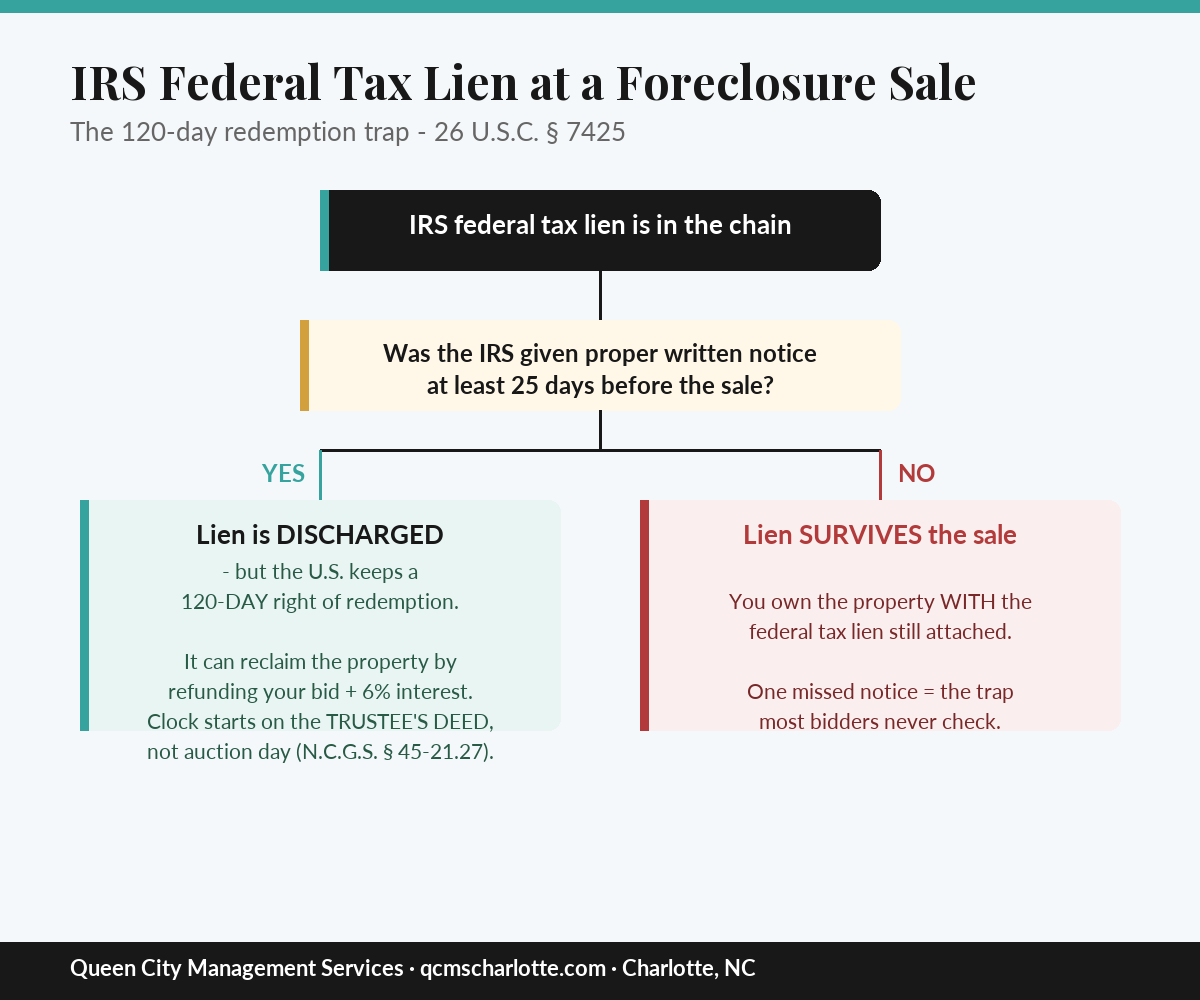
The NC State Tax Advantage. When the NC Department of Revenue dockets a certificate of tax liability under N.C.G.S. § 1-234, it behaves like a standard docketed civil judgment, taking priority from its docketing date. Docketed after the first deed of trust and properly noticed, it is completely extinguished by the foreclosure — with no 120-day redemption right. The state-lien case may be a clean buy the crowd is fleeing for no reason. That’s mispriced inventory.
What about court judgments and criminal restitution liens?
Answer: A docketed civil judgment is a lien on the debtor’s real property in that county for 10 years from its docketing date; junior ones are wiped by a senior foreclosure like any other row-5 lien. Restitution splits by court: a North Carolina restitution order docketed as a civil judgment behaves like any judgment lien, while federal criminal restitution is enforced like a federal tax lien and demands the same caution as an IRS lien.
A docketed civil judgment (G.S. § 1-234) attaches to the debtor’s real property in the county of docketing for 10 years, with priority from its docketing date. A North Carolina restitution order docketed as a civil judgment (G.S. § 15A-1340.38) slots into the race the same way. Federal criminal restitution (18 U.S.C. § 3613) is the one to respect: it is enforced like a federal tax lien and can run up to 20 years. Treat a federal restitution lien in the chain with the same caution as an IRS lien — verify the United States was properly noticed, and expect title insurers to treat federal redemption rights conservatively until they lapse.
When do these liens expire? The statute-of-limitations layer
Answer: A lien on the record is a claim, not proof the claim is still enforceable. NC civil judgments run 10 years from docketing; mechanics’ liens die if suit isn’t filed within 180 days; IRS tax liens generally expire 10 years after assessment unless tolled. Every lien in the stack has a clock:
| Lien | The clock | Statute |
|---|---|---|
| IRS federal tax lien | 10 years from assessment (the CSED); self-releases when it expires — unless tolled (bankruptcy, offer-in-compromise, hearings) or refiled | 26 U.S.C. § 6502; § 6325(a) |
| Federal criminal restitution | 20 years from judgment, plus any incarceration time | 18 U.S.C. § 3613(b) |
| NC docketed judgments (incl. NCDOR certificates) | 10 years from docketing; the lien isn’t extended by re-docketing, though a creditor may bring a fresh action on the judgment before it lapses | G.S. § 1-234; § 1-47 |
| NC property taxes | Lien holds until paid; the county has 10 years to foreclose | G.S. § 105-378 |
| Mechanics’ liens | The fastest clock: file within 120 days of last work, sue within 180 days — or it dies | G.S. § 44A-12; § 44A-13 |
What this means at the auction: that scary 2013 judgment in the title search may be a paper tiger — ten years gone, lien dead, and the crowd is still discounting for it. That’s mispriced inventory in your favor. The reverse trap is the IRS: the 10-year clock pauses during bankruptcies, offers-in-compromise, and appeals, so an old federal lien can be very much alive past year ten. Rule: date every lien in the file, then verify the dead ones are actually dead — a title attorney can confirm an expired judgment in minutes, and an IRS payoff request will state the collection deadline.
Which liens survive every foreclosure, no matter what?
Answer: Four categories survive: (1) local property taxes and assessments, which G.S. § 105-356 places above everything — “superior to all other liens… regardless of whether acquired prior or subsequent”; (2) any lien senior to the one being foreclosed; (3) junior liens whose holders were not properly noticed; and (4) mechanics’ liens with earlier first-furnishing dates, which can relate back ahead of a deed of trust recorded mid-project. Budget the property-tax payoff into every bid — in a county tax foreclosure under G.S. § 105-375, that tax lien is the very thing being enforced.
When can you actually get title insurance on an auction purchase?
Answer: Four gates, in order. First, the upset-bid period must run: no NC foreclosure sale is final until 10 days pass without a raised bid, and each raise (minimum 5%, at least $750) restarts the clock under G.S. § 45-21.27. Second, the foreclosure must be procedurally clean — underwriters review the SP file for proper notice on every junior lienholder under G.S. § 45-21.16, servicemember status, and no bankruptcy stay at sale. Third, any federal redemption right must be resolved — 120 days lapsed or a release in hand. Fourth, surviving liens get excepted: the policy you’re offered may be insurable title with carve-outs rather than marketable title. Know the difference before you sign a flip contract that promises marketable title.
How do real estate investors profit from dirty titles in North Carolina?
Answer: Investors profit by underwriting calculated title risks that scare off uninformed bidders. Everything above describes risk — but priced risk is the whole business. A title problem the crowd can’t diagnose is a discount you can underwrite:
- The IRS-lien discount: buy at the fear price, secure the property, wait out the 120-day redemption window doing zero rehab, then build equity with clean title. You were paid four months of patience.
- The NCDOR misread: the crowd treats state liens like federal ones. They aren’t. Verify docketing date and notice, and buy clean at a dirty price.
- The junior-position play: second-mortgage and HOA sales priced correctly against the senior payoff — equity positions the flip crowd won’t touch.
- The cure-and-quiet route: for genuine defects — missed notice, chain gaps — North Carolina’s quiet title action under G.S. § 41-10 clears clouds through the courts. It takes months and legal fees; it also takes a property nobody could finance and makes it marketable. (South Carolina runs quiet title differently — that’s its own upcoming article.)
The money in courthouse auctions isn’t made by avoiding dirty titles — it’s made by reading the file well enough to know which one washes off.
How is a North Carolina property tax foreclosure different from a mortgage foreclosure?
Answer: Property tax foreclosures and mortgage foreclosures run in opposite directions under North Carolina law. A mortgage foreclosure extinguishes junior liens while leaving senior mortgages and property taxes standing. Conversely, a property tax foreclosure enforces a super-priority lien, allowing the taxing entity to extinguish mortgages, judgments, and junior liens if all record lienholders are properly joined.
While a standard mortgage foreclosure under N.C.G.S. Chapter 45 wipes out junior liens, local property taxes always survive. A property tax foreclosure does the opposite: it forecloses the most senior lien of all under G.S. § 105-356. When the county forecloses and properly joins all lienholders of record, the auction can extinguish the mortgages, judgments, and junior claims that a standard mortgage sale would have left standing. The winning bidder at a tax sale takes title relatively free of underlying mortgages — the inverse of a standard foreclosure.
North Carolina forecloses delinquent property taxes in two ways:
- Judicial Foreclosure Action: a formal court action “in the nature of” a mortgage foreclosure under G.S. § 105-374.
- In Rem Foreclosure: a streamlined, expedited execution procedure under G.S. § 105-375.
Both methods protect the tax lien’s super-priority status. However, every lienholder of record must be formally served or made a party. This creates a critical trap for bidders: if a mortgage holder is not properly joined or noticed, their underlying mortgage lien survives the tax sale.
Two cautions before you treat a tax sale as a mortgage-wiping shortcut. First, federal tax liens still get their notice-and-redemption treatment even here — join the United States, or the IRS lien survives. Second, note the terminology: North Carolina is a tax-foreclosure state that produces a commissioner’s or sheriff’s deed through the courts — not a pure “tax lien certificate” state. South Carolina, where we also bid, runs a redemption-based tax sale with its own timeline and surplus rules — that’s its own upcoming article.
— Halah Kablan Ladson, Broker-in-Charge at Queen City Management Services
Key Real Estate Legal Definitions
Cloud on title — anything attached to the ownership that someone else can point to: a surviving lien, an unreleased deed of trust, a missing heir, a bad legal description. The ownership is real; the clouds are why two identical houses price differently at the same auction.
Quiet title (G.S. § 41-10) — the lawsuit that settles disputed ownership and wipes stale claims: competing deeds, heirs arguing over granddad’s land, gaps in the chain. The judge hears every claim and declares the owner; every other claim dies.
Marketable title — ownership clean enough that a buyer, a lender, and a title insurer will all accept it without argument. It’s what you need to sell or refinance — a higher bar than owning. NC’s Marketable Title Act (Chapter 47B) kills most claims older than 30 years, but won’t cure the fresh clouds auction buyers face.
Title insurance — an underwriter’s promise to defend and pay if a covered problem surfaces later. Insurers read the same public records you should have read and except every known cloud from coverage — which makes a title commitment the cheapest diligence document in real estate: a professional’s list of exactly what’s attached to the ownership you’re about to buy.
Frequently Asked Questions
Does a first-mortgage foreclosure in NC wipe out a second mortgage? Generally yes — a properly conducted first-position foreclosure with proper notice under G.S. § 45-21.16 extinguishes junior deeds of trust, with junior holders paid only from any sale surplus. It never wipes out property taxes or liens senior to the foreclosed deed of trust.
Can the IRS really take a property back after a foreclosure auction? Yes. If a junior federal tax lien was properly noticed, the U.S. holds a 120-day right of redemption after the sale and can reclaim the property by refunding your bid plus 6% interest and limited costs. If the IRS wasn’t noticed, the lien survives outright.
Do NC property taxes ever get wiped out at auction? Never. G.S. § 105-356 makes local property tax liens superior to all other claims. Always factor the delinquent-tax payoff into your maximum bid.
How long until an NC foreclosure sale is final? Ten days after the report of sale is filed with the clerk under G.S. § 45-21.27, provided no upset bid is placed. Each valid upset bid (minimum 5% increase, at least $750) resets that 10-day clock.
Is buying at an HOA foreclosure auction a good deal? Only with eyes open: an HOA foreclosure under Chapter 47F extinguishes nothing senior to the HOA’s lien, so the first (and any second) mortgage survives. The low price buys an equity position subject to that debt.
Bidding at a Carolina courthouse auction, or building a rental portfolio in Charlotte? Queen City Management Services helps investors underwrite, acquire, and manage single-family and multi-family property across Charlotte and the Carolinas. Talk with us at qcmscharlotte.com or call 704-941-4557.
Disclaimer: This article provides general educational information about North Carolina real estate transactions and is not legal advice. Foreclosure bidding carries real financial risk; always review a full title report and consult a licensed North Carolina real estate attorney and title abstractor before bidding on property.
Related: For the HOA-specific angle — how these lien rules play out when an association forecloses, and what a bidder inherits — see HOA Foreclosures in North Carolina: An Investor’s Strategy for the Courthouse Auction.
References & Legal Authority
- N.C.G.S. § 47-18 — Conveyances; registration (the pure race statute; Connor Act of 1885)
- N.C.G.S. Chapter 45, incl. §§ 45-21.16 (notice) and 45-21.27 (upset bids) — power-of-sale foreclosure
- N.C.G.S. § 105-356 — Priority of tax liens; § 105-375 — in rem tax foreclosure; § 105-378 — limitation on tax foreclosure
- N.C.G.S. Chapter 44A (§§ 44A-12, 44A-13) — mechanics’ and materialmen’s liens; relation-back
- N.C.G.S. § 1-234 — judgment docketing and lien; § 1-47 — limitation on actions on a judgment
- N.C.G.S. § 15A-1340.38 — restitution docketed as a civil judgment
- N.C.G.S. § 41-10 — quiet title; Chapter 47B — Marketable Title Act; Chapter 47F — Planned Community Act (HOA)
- 26 U.S.C. § 7425 — discharge/redemption of federal tax liens in nonjudicial sales; 28 U.S.C. § 2410(c) — 120-day redemption period; 26 U.S.C. §§ 6502, 6325 — IRS collection period and lien release; IRM 5.12.5
- 18 U.S.C. § 3613 — enforcement of federal criminal restitution (enforced as a tax lien)
About the Author
Halah Kablan Ladson is Broker-In-Charge of Queen City Management Services (QCMS) in Charlotte, North Carolina. She has worked in real estate for 22 years across four states and has operated QCMS since 2013. NC License No. 272964 · SC License No. 107533 · NC Firm No. C24768 · Est. 2013. Connect with Halah on LinkedIn.
Last updated: September 2026
One Response