
You have done your research — you drove by the auction property, walked the block, took photos and video, pulled the court file, and (hopefully) pulled title. Now you have decided to bid at a foreclosure auction here in Mecklenburg County. You fill out the court paperwork, walk into the courthouse with your cashier’s check, hand it to the Clerk of Court, and get a stamped copy and a receipt. Your bid is registered. Now what?
Here is what happens: nothing final — for at least 10 more days. In North Carolina, winning the auction is not winning the property. Every foreclosure sale stays open for a 10-day upset bid period, during which anyone can outbid you by as little as 5% (minimum $750) and take your position. Each new bid restarts the clock. The property is only yours when 10 days pass in silence. At Queen City Management Services (QCMS), we have bought out of the Charlotte and Mecklenburg County courthouse pipeline for over a decade — below is exactly how the upset bid process works, statute by statute, dollar by dollar.
Ten days can feel long — especially on a hot property. A common play: an investor waits until the last day of the window to file an upset, restarting the clock for another full 10 days. It is usually strategic — the longer the bidding drags, the more competitors drop out, and it buys time to line up the cash to close.
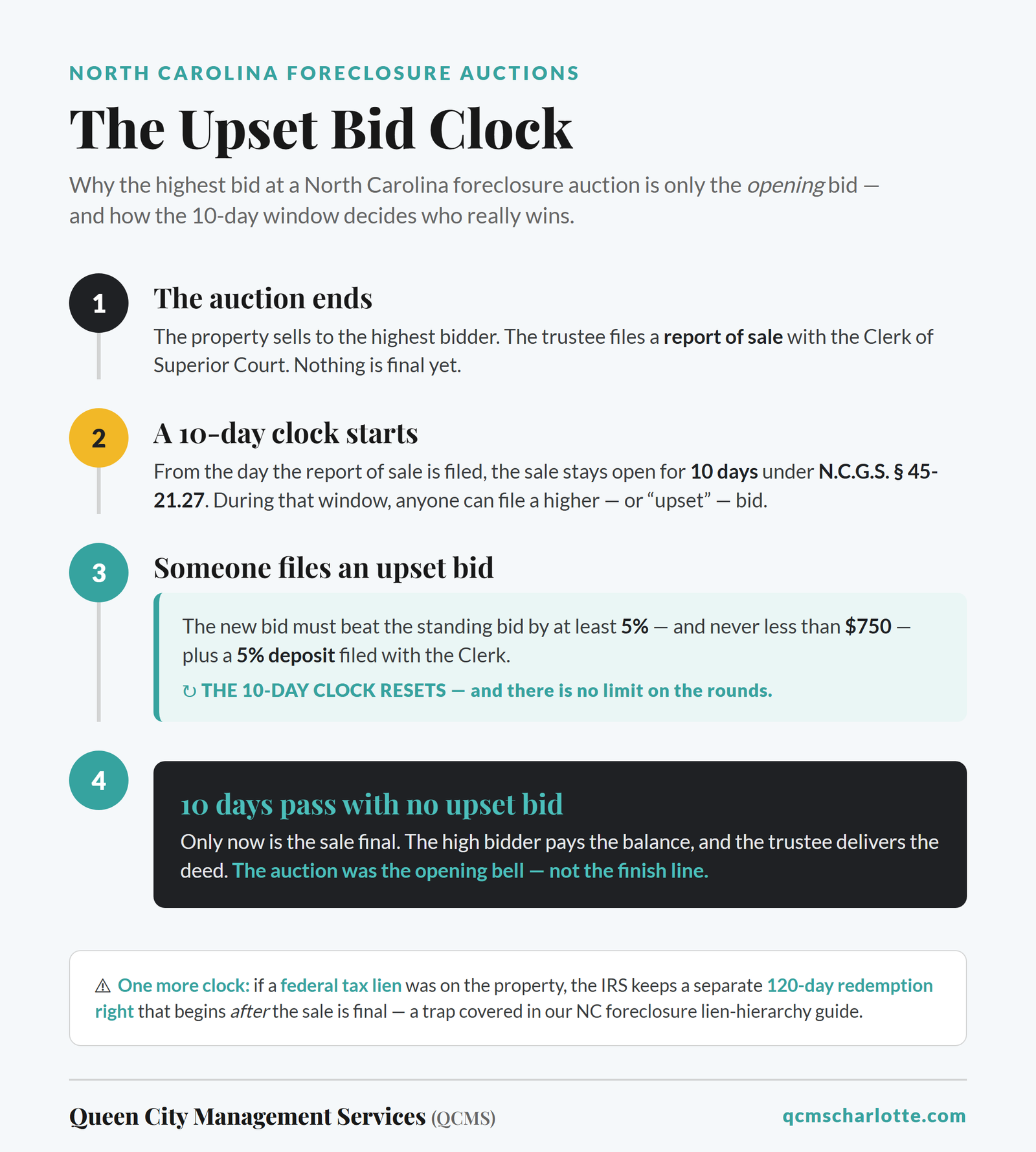
The NC upset bid clock — start to finish
Here is the entire clock at a glance, from the gavel to a final, deliverable deed:
| Step | What happens | The rule |
|---|---|---|
| 1. The auction ends | Property sells to the highest bidder; the trustee files the report of sale with the Clerk of Superior Court. | Nothing is final yet |
| 2. A 10-day clock starts | The sale stays open 10 calendar days; anyone may file a higher “upset” bid. | N.C.G.S. § 45-21.27 |
| 3. An upset bid is filed | Must beat the standing bid by ≥5% (minimum $750), plus a 5% deposit in certified funds — and the 10-day clock resets. | No limit on rounds |
| 4. 10 days pass, no upset | The sale is final; the balance is due and the trustee delivers the deed. | The property is yours |
What is an upset bid in North Carolina?
An upset bid is a higher bid filed after the auction is over. Under N.C.G.S. § 45-21.27, every North Carolina power-of-sale foreclosure stays open for 10 days after the report of sale is filed, and any person may take the winning position by bidding at least 5% more (minimum $750) and posting a deposit with the Clerk of Superior Court. The same mechanics govern judicial sales under N.C.G.S. § 1-339.25.
Why does NC do this? The upset bid system exists to squeeze the maximum price out of every forced sale. Every extra dollar bid pays down the debt, and anything left over belongs to the former owner. The legislature decided a 10-day open season serves borrowers and creditors better than a single moment of courthouse-step competition. For buyers, that policy has a sharp edge: your auction win is an opening offer, published for the world to see.
How long does the upset bid period last — and does it really restart every time?
Ten days from the filing of the report of sale — and yes, every upset bid restarts the full 10 days. There is no limit on the number of rounds. Two determined bidders can stretch a single foreclosure across months, 5% at a time. The sale is only final when a full 10-day window closes with no new bid.
The days are calendar days, not business days. One mercy in the statute: if Day 10 lands on a weekend, holiday, or any day the courthouse is closed, the deadline rolls to the next day the clerk’s office is open for business.
How much does it cost to file an upset bid?
Two numbers, straight from N.C.G.S. § 45-21.27: your bid must beat the standing bid by at least 5% — never less than $750 — and you must post a deposit of 5% of your bid (again, minimum $750) in cash, certified check, or cashier’s check. Personal checks and wire promises do not exist in this process.
Where do you file an upset bid in Mecklenburg County?
At the Clerk of Superior Court, 832 East 4th Street, Charlotte — the same office holding the case file. Your notice of upset bid must state your name, address, phone number, and bid amount (N.C.G.S. § 1-339.25 spells out the contents), and it must be in — deposit included — by the close of normal business hours on Day 10. Not postmarked. In the building, stamped, paid.
Get the stamped copy and keep it with the receipt. That stamp is your position.
— Halah Kablan Ladson, Broker-in-Charge, QCMS
Can you get financing for a courthouse auction property in NC?
Not the way buyers usually expect. A foreclosure bid in North Carolina is unconditional — there is no financing contingency, no inspection contingency, no backing out because a loan fell through. You post certified funds the moment you bid, and the full balance is due when the sale becomes final. Fail to pay, and N.C.G.S. § 45-21.30 makes it expensive: the clerk can order a resale, your deposit is applied against the damage, and you remain personally liable for any shortfall plus the costs of the resale.
So how do buyers who are not sitting on full cash actually do this? Three real paths:
- A hard-money or private lender committed BEFORE auction day. Here is the twist out-of-state investors miss: NC’s 10-day upset window — the thing that torments buyers — is a financing gift. In same-day-payment states, fast money has hours. Here, a pre-committed lender has the entire window to fund while you wait out the clock. Commitment first, bid second.
- Your own liquid money now, a refinance later. Buy with a HELOC, savings, or equity pulled from another property, then do a cash-out refinance into a conventional loan after the deed records. This two-step is the standard investor play: short-term money wins the property, long-term money holds it.
- The path that does not exist: a traditional contingent purchase mortgage. No bank will underwrite a house you cannot walk inside, do not control, and might lose to a day-9 upset bid. The timeline fails, the appraisal fails, the collateral fails. Do not waste the application fee.
The courthouse does not care how you got the money. Cash talks; contingencies were never invited.
I funded my first purchase through sweat equity — I did a JV with one of my property management clients. He trusted me: I did the research, the bidding, and the acquisition admin; he provided the funds. We won the bid, I put it on the market, and it sold six days later. I was hooked after that.
— Halah Kablan Ladson, Broker-in-Charge, QCMS
How does the upset bid period affect title transfer?
No deed moves until the window closes quiet. The trustee or commissioner delivers the deed only after a full 10-day period passes with no new bid (and, in judicial sales, after confirmation). That means you cannot schedule a closing, place insurance cleanly, or take possession off an auction win alone — you hold a position, not a property. And when the window does close, possession is its own statutory track, not a landlord eviction — here is taking possession when occupants remain.
Plan for the limbo: the property sits in between — you do not own it, and the former owner’s incentive to maintain it is gone. Budget the wait into your numbers, and remember the deed you eventually receive transfers ownership, not a clean title — liens ride along exactly as our NC lien hierarchy guide lays out, and HOA liens carry their own trap.
Do upset bids apply to NC tax foreclosure sales too?
Yes. Tax foreclosures under N.C.G.S. § 105-374 run through the judicial sale procedure, which carries the same upset bid mechanics via N.C.G.S. § 1-339.25 — 10 days, 5%, $750 floor, filed with the clerk. The difference is who runs the sale (a commissioner for the county rather than a deed-of-trust trustee) and what survives it. If you hunt tax sales, the upset window is the same second auction it is on the mortgage side.
When is an NC foreclosure sale actually final?
Count it out: report of sale filed, then a full 10-day window with zero upset bids. Then — and only then — is the high bid locked, the balance due, and the deed deliverable. One caveat survives even that finality: if a properly noticed federal tax lien was on the property, the IRS holds a 120-day right of redemption from the sale — rare in practice, but real. We covered that clock, and every other lien that lives or dies at auction, in the lien hierarchy pillar.
Can you lose a property you already won the bid on?
Yes, 100% — I’ve lost a few bids myself — because we could not close after the auction and the 10-day upset window finalized. And we did not wholesale the contract either (that can be a separate article down the road). Trying to get your deposit back is an entire separate process as well.
— Halah Kablan Ladson, Broker-in-Charge, QCMS
The lesson every investor learns once: line up committed money before you bid, not after. The clock does not wait, and the penalty for a failed close is real.
FAQ: NC upset bids
How does an upset bid work in North Carolina?
After any foreclosure sale, the sale stays open 10 days. Anyone may file a higher bid with the Clerk of Superior Court — at least 5% above the standing bid, minimum $750 — with a 5% deposit in certified funds. Each upset bid restarts the 10-day clock.
Does the 10-day upset period include weekends?
Yes — they are calendar days. But if Day 10 falls on a weekend, holiday, or a day the courthouse is closed, the deadline extends to the next business day.
Do I get my deposit back if someone outbids me?
Yes. When a valid upset bid is filed, the prior bidder’s deposit is released. You only forfeit a deposit by winning and then failing to pay — which also leaves you liable for any resale shortfall under N.C.G.S. 45-21.30.
Can you finance a courthouse auction purchase in NC?
Not with a traditional contingent mortgage — auction bids are unconditional. Investors line up hard-money or home-equity funds before bidding, then refinance after the deed records. The 10-day upset window gives a pre-committed lender time to fund.
Can the homeowner stop the sale during the upset period?
In limited ways — reinstatement or payoff arrangements with the lender, or bankruptcy’s automatic stay, can halt the process before the sale is final. Once the upset period closes and the deed is delivered, the owner’s window has effectively shut, except the rare federal redemption right.
How many times can a property be upset bid?
There is no statutory limit. Each upset bid opens a fresh 10-day window, and chains of successive bids can run for months.
When do I actually get the deed?
After a 10-day window closes with no new bid and you pay the balance in full — the trustee or commissioner then delivers the deed. Ownership transfers at that point; the title’s condition is a separate question.
Where do I file an upset bid in Mecklenburg County?
Clerk of Superior Court, 832 E. 4th Street, Charlotte — the notice of upset bid plus the deposit, by close of business on Day 10.
The bottom line
In Charlotte and across North Carolina, a foreclosure auction is the opening bell, not the finish line. The 10-day upset clock decides who really buys the property — and the buyers who win consistently are the ones who bring committed money, watch the filings, and count the days. Queen City Management Services (QCMS) has worked Mecklenburg County foreclosure and investment property for over a decade; if you are building a rental portfolio out of the courthouse pipeline, our investment property services show how we take a courthouse win to a performing rental.
About the Author
Halah Kablan Ladson is Broker-In-Charge of Queen City Management Services (QCMS) in Charlotte, North Carolina. She has worked in real estate for 22 years across four states and has operated QCMS since 2013. NC License No. 272964 · SC License No. 107533 · NC Firm No. C24768 · Est. 2013. Connect with Halah on LinkedIn.
Last updated: September 2026
2 Responses