
By Halah Kablan Ladson · Broker-In-Charge · Queen City Management Services · Licensed NC/SC · NC License No. 272964 · NC Firm No. C24768 · Est. 2013 · Last updated: September 2026
Most Charlotte residents don’t know this yet: when Senator Elizabeth Warren made the case for federal legislation to stop Wall Street from buying single-family homes, she pointed to three cities as the markets where the problem is most concentrated. Not Phoenix. Not Dallas. Charlotte — alongside Atlanta and Jacksonville. The data behind that callout: companies buying more than 100 homes accounted for 5.1% of all home purchases in Charlotte between January 2023 and November 2025 — the highest share of the three cities, and more than triple the 1.6% national average. (CNBC, March 2026.)
This isn’t abstract. It’s happening on your street, in your neighborhood, and it has been happening for fifteen years. Here’s what the data shows, what Congress just did about it, why the fix may be less than it appears, and what it means for Charlotte families over the next twelve months.
How did Wall Street end up owning 20,000 homes in Mecklenburg County?
It started with the 2008 financial crisis. When the foreclosure wave hit, institutional investors — backed by private equity and government-facilitated bulk purchase programs — began buying distressed single-family homes at scale. What began as a crisis response became a business model.
By May 2021, Wall Street-backed landlords owned more than 11,000 single-family homes in Charlotte alone, according to a UNC Charlotte Urban Institute analysis of Mecklenburg County property records. By late 2023, that number had grown to approximately 20,000 — a 65% jump since 2019, controlling roughly 7.5% of all single-family homes in the county. (Charlotte Newsroom, October 2025; UNC Charlotte Urban Institute, September 2025.)
The six firms that dominate Charlotte’s market: Progress Residential (2,268 houses), American Homes 4 Rent (2,242), Invitation Homes (2,241), Tricon Residential (1,627), Amherst Residential (1,622), and FirstKey Homes (1,044). (UNC Charlotte Urban Institute, 2021.)
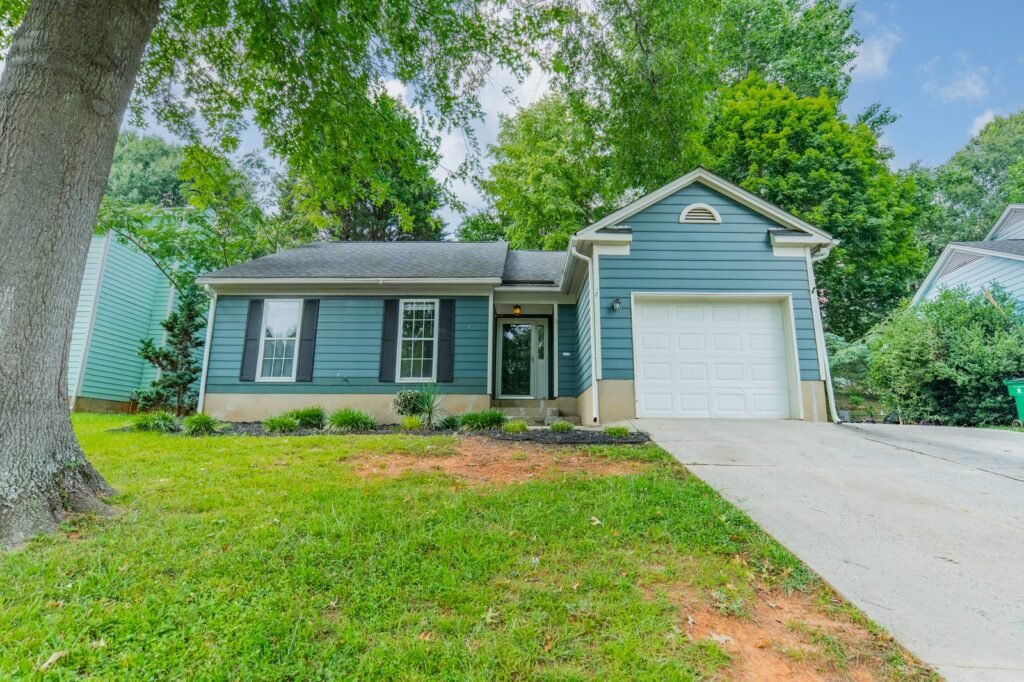
They did not buy in Ballantyne or Myers Park. They bought starter homes — the $150,000 to $300,000 range where first-generation buyers and working families enter the market. That was deliberate. Their stated strategy: target middle-income neighborhoods with strong rental demand and population growth. Charlotte checked every box.
The result in Northwest Charlotte is stark. In neighborhoods like Coulwood and Oakdale, corporate firms now own more than 20% of homes. The pattern runs through University City and into parts of Huntersville and Steele Creek. (UNC Charlotte Urban Institute, September 2025.)
“I’ve been managing property in Charlotte since 2013. I watched this happen in real time. The same houses that first-time buyers would have purchased, renovated, and built equity in — gone. Bought in bulk, turned into rentals, managed from a spreadsheet in another state.”
— Halah Kablan Ladson, Broker-In-Charge, Queen City Management Services (NC Firm No. C24768)
What did this do to home prices in Charlotte?
Charlotte’s median home price rose from approximately $295,000 in 2020 to $443,850 in September 2025 — a 50% increase in five years. (UNC Charlotte Childress Klein Center for Real Estate, State of Housing Report 2025.) At current mortgage rates near 6.5%, a household now needs approximately $146,000 in annual income to comfortably carry a median-priced Charlotte home. That income threshold has nearly doubled since 2020. (ibuyer.com Charlotte Housing Market Report, June 2026.)
The entry-level market is where the damage is most visible:
| Price range | % of Charlotte homes sold in 2014 | % of Charlotte homes sold in 2024 |
|---|---|---|
| Under $150,000 | 34.5% | 2% |
| Under $300,000 | 75% | ~19% |
(UNC Charlotte Childress Klein Center for Real Estate, State of Housing in Charlotte 2024 Report.)
Institutional investors did not cause all of this. Low interest rates, pandemic demand, population growth, and the lock-in effect all played simultaneous roles. But institutional buyers concentrated their purchases in exactly the price range that would have been the entry point for first-time buyers, in exactly the markets — Charlotte, Atlanta, Jacksonville — where the pressure was already highest.
What is the “forever renter” business model — and is it real?
American Homes 4 Rent described its Charlotte-area portfolio to investors as worth $757 million. Its stated strategy: target submarkets with “undersupplied high-growth markets” to favor “future growth in rents and valuations.” (UNC Charlotte Urban Institute, 2021.)
These companies don’t make money when renters buy homes. They make money when renters keep renting. A national study found that fewer than one in five single-family renters said they would try to buy a home if they could no longer live in their current rental — with 42% citing cost as the primary barrier and 56% saying renting a single-family home gave them access to neighborhoods they otherwise couldn’t afford. (Multi-Housing News, February 2026.)
The wealth implications are documented. The average homeowning household’s net worth is $1.626 million. The average renting household’s net worth is $162,444. (iPropertyManagement Research, May 2026.) Homeownership has historically been the primary mechanism through which American working families build generational wealth. A market structure that converts starter homes into permanent rentals removes that mechanism — quietly, legally, and at scale.
The homeownership rate dropped to 65% in Q2 2025 — its lowest level since 2019. First-time buyers fell to just 21% of home purchases, a historic low. Among adults under 35, the homeownership rate sits at 36.4%. (NAHB, July 2025.)
What did Congress actually do about it?
On January 20, 2026, President Trump signed Executive Order 14376 — “Stopping Wall Street from Competing with Main Street Homebuyers” — directing the Treasury Secretary to develop definitions and restrictions on large institutional investor purchases of single-family homes. (White House, January 20, 2026.)
On March 12, 2026, the Senate passed the 21st Century ROAD to Housing Act by a vote of 89 to 10 — bipartisan, co-sponsored by Sen. Tim Scott (R-SC) and Sen. Elizabeth Warren (D-MA). The core provision, titled “Homes are for people, not corporations,” prohibits any large institutional investor from purchasing additional single-family homes. (NPR, March 12, 2026.)
After negotiations between the chambers, Congress passed the final version in late June 2026 — the Senate 85 to 5 on June 22, the House 358 to 32 on June 23. The 21st Century ROAD to Housing Act became law on July 11, 2026 — without President Trump’s signature. Trump declined to sign or veto the bill before the constitutional deadline, stating on Truth Social that he withheld his signature “in protest” of the Senate’s failure to pass the unrelated SAVE America Act voting bill. (NPR, July 10, 2026; HousingWire, July 11, 2026.)
The law defines “large institutional investor” as any for-profit entity with direct or indirect investment control of 350 or more single-family homes — covering funds, REITs, LLCs, partnerships, and joint ventures, including entities acting “in concert with other entities.” (21st Century ROAD to Housing Act, Section 1001.)
What the law does NOT do — and where Wall Street can still maneuver
No divestiture required. The 20,000 homes already owned in Mecklenburg County stay exactly where they are. Invitation Homes keeps its 2,241 Charlotte homes. Progress Residential keeps its 2,268. The law stops new purchases — it does not undo fifteen years of accumulation.
Build-to-rent communities are explicitly exempted. Institutional investors cannot buy existing homes from families — but they can still build entire new subdivisions designed as permanent rentals and own them indefinitely. The 7-year forced sale requirement was eliminated in the final bill. No renter right of first refusal. No disposal timeline. A firm can build a 300-home subdivision in Steele Creek or Concord and own every house as a rental community forever. (Baker Botts, June 2026.)
The 350-home threshold creates a compliance gray zone. The final regulations defining “investment control” have not been written yet. Treasury has rulemaking authority — and the law specifically requires Treasury to consider “market-disruption mitigation” when writing those rules. The real estate industry’s legal teams are already mapping compliance structures. (Baker Botts, June 2026; Morgan Lewis, July 2026.)
Renovate-to-rent remains available. Investors can still purchase homes that fail to meet structural or core system elements of local building codes and rent them after renovation — as long as improvements total at least 15% of the purchase price.
The law sunsets in 15 years. The prohibition is not permanent. It automatically expires 15 years after taking effect unless Congress acts again. (Mayer Brown, March 2026.)
“The legislation is a real signal. Congress voted 89 to 10 in the Senate — that’s not a partisan issue, that’s a consensus. But the 20,000 homes already in corporate hands in Mecklenburg County don’t move. The starter home inventory that disappeared between 2019 and 2024 doesn’t come back. This law closes the door going forward — it doesn’t return what Charlotte families already lost.”
— Halah Kablan Ladson, Broker-In-Charge, Queen City Management Services (NC Firm No. C24768)
What may happen in Charlotte over the next 6 to 12 months
Nothing changes immediately. The law takes effect 180 days from July 11, 2026 — January 7, 2027.
The existing corporate inventory stays put. Renters currently in Invitation Homes, Progress Residential, or American Homes 4 Rent properties in Charlotte will continue renting from those companies. Leases renew. No forced sales. No sudden inventory release.
Build-to-rent development accelerates before regulations tighten. Institutional investors who cannot buy existing homes will accelerate investment in BTR subdivisions — the one category explicitly protected. Expect more purpose-built rental communities in the outer Charlotte suburbs: Concord, Gastonia, Fort Mill, Steele Creek.
Starter home inventory may gradually loosen — but slowly. With institutional buyers removed from the existing home purchase market, competition at the entry-level price point decreases marginally. First-time buyers who have been losing bids to cash-offer institutional buyers may find slightly more breathing room. But the underlying supply gap doesn’t close overnight.
Treasury rulemaking will determine how much the law actually does. The practical impact will be written in federal regulations over the next 12 to 24 months. Industry lobbying is already underway to broaden exceptions. The final rules will determine whether the law meaningfully curtails institutional investment or creates a compliance roadmap that leaves most of the existing model intact.
Charlotte remains one of the most watched housing markets in the country. Charlotte was one of the three cities Senator Warren singled out when making the case for the law, because the concentration here — 18% of the single-family rental market controlled by institutional investors per the GAO, behind only Atlanta (25%) and Jacksonville (21%) — is among the highest in the nation.
What this means if you own property in Charlotte
If you own investment property in Charlotte, you are not affected by this law — it applies only to entities controlling 350 or more homes. The vast majority of individual investors and small landlords are entirely outside its scope.
What it does mean: the competitive pressure from institutional buyers at the acquisition stage decreases. If you have been looking to add a property to your portfolio in the $200,000 to $350,000 range — the segment where institutional buyers have been most active — the bidding environment may become modestly more favorable over the next 12 to 18 months.
If you have been sitting on the sideline waiting to see what happens with rates and inventory, this is a reasonable time to have a conversation about what the Charlotte rental market looks like today and what yield expectations are realistic in 2026 and beyond.
Queen City Management Services has managed investment property in Charlotte since 2013 — through the institutional investor wave, through the pandemic price surge, and now through the first federal legislation to address it directly. NC Firm No. C24768. Licensed NC and SC.
Ready to maximize your rental property? Talk to us about managing your Charlotte investment property →
Navigating university rentals? Get the free 2026 UNCC Off-Campus Housing Guide →
Sources
UNC Charlotte Urban Institute — “Wall Street-backed landlords now own more than 11,000 single-family homes in Charlotte” (2021) · UNC Charlotte Urban Institute — “Understanding Corporate Landlords: Where are they in Mecklenburg County?” (September 2025) · Charlotte Newsroom — “Big Companies Now Own 20,000 Mecklenburg Homes, 65 Percent Jump Since 2019” (October 2025) · UNC Charlotte Childress Klein Center for Real Estate — State of Housing in Charlotte 2024 Report (November 2024) · State of Housing Report 2025 (October 2025) · U.S. GAO — Rental Housing: Information on Institutional Investment in Single-Family Homes (May 2024) · Morgan Lewis — “Congress Limits Institutional Acquisition of Single-Family Homes” (July 2026) · Baker Botts — “The 21st Century ROAD to Housing Act: Congress Passes Final Bill” (June 2026) · NPR — “Senate passes bipartisan housing bill targeting large investors” (March 12, 2026) · NPR (July 10, 2026) · HousingWire (July 11, 2026) · CNBC (March 2026) · White House Executive Order 14376 (January 20, 2026) · NAHB — “Homeownership Rate Hits Lowest Level Since 2019” (July 2025) · iPropertyManagement Research — Renters vs. Homeowners Statistics (May 2026) · ibuyer.com Charlotte Housing Market Report (June 2026) · Multi-Housing News (February 2026) · Federal Reserve Bank of Richmond — Econ Focus Q4 2024.
Queen City Management Services · NC Firm No. C24768 · Licensed NC & SC · Halah Kablan Ladson, Broker-In-Charge · NC License No. 272964 · Est. 2013 · Charlotte · Matthews · Huntersville · Concord · Rock Hill · Mecklenburg · Union · Gaston · York County SC
About the Author
Halah Kablan Ladson is Broker-In-Charge of Queen City Management Services (QCMS) in Charlotte, North Carolina. She has worked in real estate for 22 years across four states and has operated QCMS since 2013. NC License No. 272964 · SC License No. 107533 · NC Firm No. C24768 · Est. 2013. Connect with Halah on LinkedIn.
Last updated: September 2026