
If you own a rental property in Charlotte and it took longer to lease this year, you probably noticed.
Maybe you listed at roughly the same rent as last year. The photos were good. The property showed well. You were getting inquiries. But it sat — five days, then ten, then twenty, and at some point the question became: what changed?
Halah Kablan Ladson, Broker-in-Charge of Queen City Management Services (QCMS), heard a version of that question from Mecklenburg County rental owners all year. So QCMS pulled the Canopy MLS data directly — the first time anyone has analyzed days-to-lease for Charlotte rental houses this way, because the published rental reports don’t track it at all.
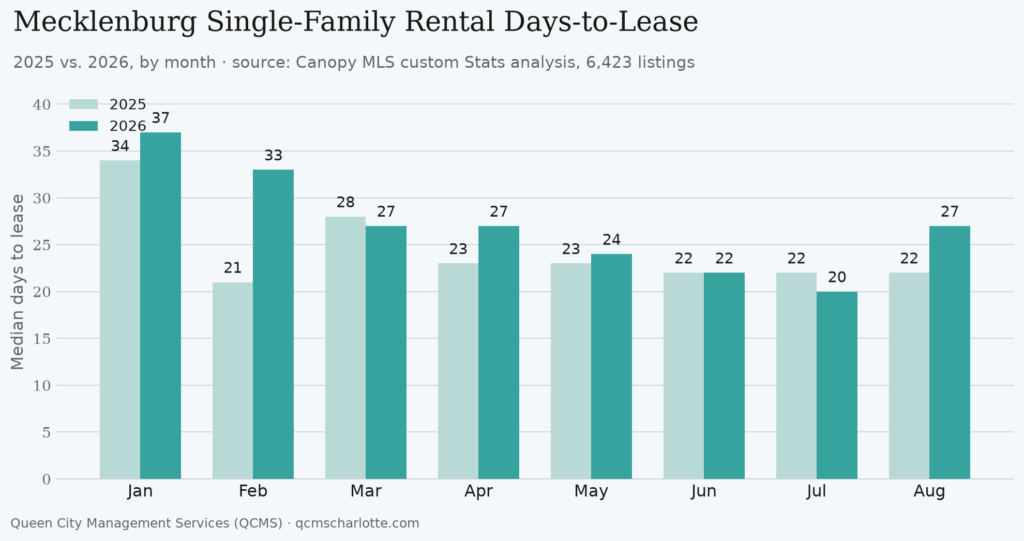
The finding in one sentence: Charlotte’s single-family rentals held their asking rents from April through August 2026, but took about 11% longer to lease than the same months in 2025. The pressure showed up in vacancy time before it showed up in rent cuts.
Deciding whether to hold or sell a Charlotte rental? The Rent vs. Sell Calculator runs your numbers against the data below.
Did Charlotte rents actually go down in 2026?
Only on the apartment side, and even there it’s turning. Matthews Real Estate Investment Services reported average apartment asking rent of $1,516 in Q1 2026, down 3.2% year over year, with vacancy at 6.2% and roughly 18,000 units under construction (Matthews Real Estate Investment Services, Q1 2026). By Q2, effective rent had risen to $1,539, the annual decline had narrowed to 1.24%, and vacancy eased to 5.58% (Matthews, Q2 2026). The apartment market didn’t keep falling through 2026 — it started turning. That’s the first real sign 2026 was a bottom, not a slide.
Single-family houses never discounted that way. That’s a different story, and it’s the one the apartment data can’t tell.
How long are Charlotte single-family rentals taking to lease?
Six-thousand-four-hundred-twenty-three. That’s how many single-family rental listings QCMS pulled from Canopy MLS across Mecklenburg County, January 2025 through August 2026, compared month by month — because Canopy’s own published rental report has no days-on-market field at all.
| Month | 2025 median days | 2026 median days | Change |
|---|---|---|---|
| Jan | 34 | 37 | +3 |
| Feb | 21 | 33 | +12 |
| Mar | 28 | 27 | −1 (faster) |
| Apr | 23 | 27 | +4 |
| May | 23 | 24 | +1 |
| Jun | 22 | 22 | flat |
| Jul | 22 | 20 | −2 (faster) |
| Aug | 22 | 27 | +5 |
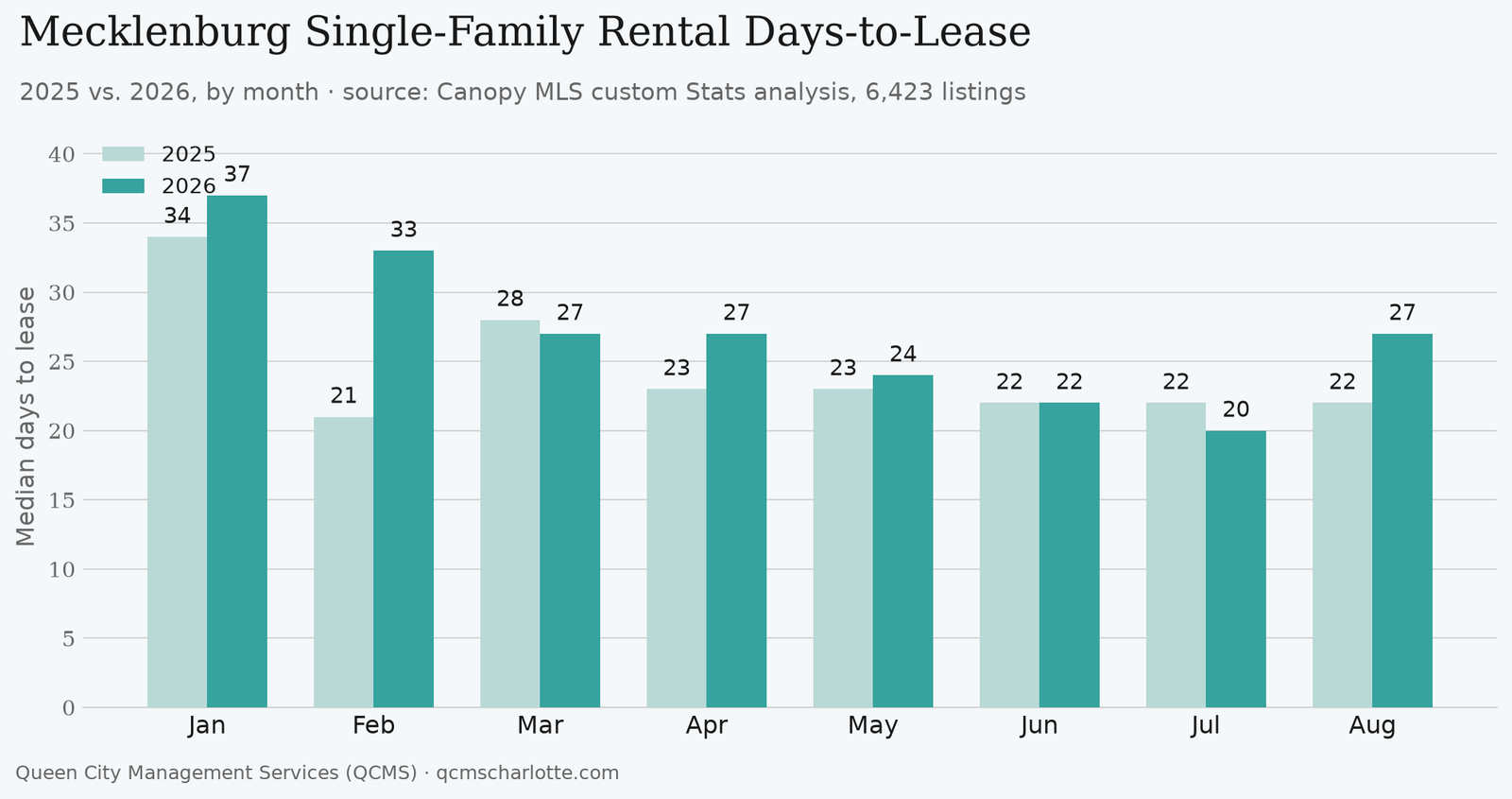
The average of those monthly medians moved from 24.4 days in 2025 to 27.1 in 2026 — an 11% increase. Five months took longer. One was flat. Two — March and July — were actually faster. August was the sharpest swing: 22 days to 27, up nearly 23%.
Run the same query across all residential rentals, including condos and townhomes, and the gap widens to 28 days versus 32 — up 14% across 10,817 listings. Condos, concentrated where the apartment towers went up, are carrying more of the slowdown than houses are.
The Charlotte Ledger independently reported on this analysis in Ashley Fahey’s September 30, 2026 piece, The New Math on Rental Houses, and Ladson discussed the same findings on the Investor Fuel Real Estate Pros Show.
Owners didn’t cut the rent. They waited.
From April through August, the median single-family lease closed at exactly 100% of its original asking rent — in both 2025 and 2026. Five consecutive months, two years running, no change at all.
January was softer — 96.3% against 98.4% a year earlier — but from spring on, the typical Charlotte rental house leased for exactly what it was listed for. The slower market got absorbed as vacancy, not as a lower price. Apartment operators discounted on price; individual owners paid in time instead.
“My owners do need to spend more money to get the houses in shape with the renters, because renters [today] have more options,” Ladson told The Charlotte Ledger.
What that actually cost: Canopy’s trailing-12-month average Mecklenburg lease price is about $2,211 a month — roughly $72.69 a day (Canopy MLS, Aug 2026 rental report). The single-family analysis found leases running about 2.75 days longer in 2026, which works out to roughly $200 in additional vacancy on a typical turnover. Mecklenburg’s average lease price rose 1.0% over the same twelve months — about $265 a year on that same $2,211 lease. So on a property that turned over in 2026, the extra vacancy consumed roughly three-quarters of the entire year’s rent increase. Not all of it. Most of it.
Which is why the better question for an owner to ask isn’t how much more they can charge — it’s what it costs to hold out for it. An extra $50 a month is $600 a year. Three weeks of vacancy chasing it is roughly $1,500.
Why is this happening if Charlotte is still growing?
Because it’s growing more slowly than it was, and the pipeline was built for the old number.
The Charlotte Regional Business Alliance tracks daily in-migration to the 16-county region. That figure hit a record 157 a day, then fell to 135 for the year ending July 2025 — a 14% drop, the first decline in six years (Charlotte Regional Business Alliance, Jul 2026). Net migration fell from 57,300 to 49,324. Even the city’s headline number carries the slowdown: the 20,731 people Charlotte added between July 2024 and July 2025 — still the largest numeric gain of any U.S. city (U.S. Census Bureau, May 2026) — is down 5,052 from the year before. Charlotte remains the strongest magnet in its peer group, ahead of Austin, Atlanta, Raleigh and Nashville. Demand didn’t break.
Development runs two to three years behind. Projects permitted when arrivals were running at 157 a day delivered into a market taking 135. The region added more than 28,000 housing units in a single year — a supply wave sized for a bigger number than the one that actually showed up.
A condo near the light rail, a three-bedroom house in Steele Creek, and a new apartment in South End aren’t competing for the same tenant, even though “Charlotte rents” gets reported as one line. Over the twelve months ending August 2026, Mecklenburg’s average lease price rose 1.0% while Uptown — where the new towers landed — fell 3.1%. Huntersville gained 6.1%. Those are four different markets wearing one headline.
How is build-to-rent affecting Charlotte landlords?
This is the competitor that doesn’t show up in the MLS data at all, and it’s a closer one than most owners assume.
Build-to-rent puts professionally managed single-family houses and townhomes directly into the rental market an individual landlord competes in — not the apartment market. Nationally, an estimated 82% to 90% of single-family rentals are owned by landlords with ten properties or fewer (John Burns Research and Consulting, via the National Rental Home Council; BatchData, Sep 2025). Institutional build-to-rent is built to compete with owners like the ones reading this, not with apartment operators.
Charlotte became one of the largest build-to-rent markets in the country during the recent construction cycle — Berkadia counted roughly 4,156 BTR homes under construction across the region in January 2025, second nationally behind Phoenix (Berkadia, Jan 2025). That number has already fallen: by Q1 2026, RealPage counted 2,900 units under construction in Charlotte, fifth nationally behind Phoenix, Dallas, Atlanta and Houston (RealPage, Q1 2026).
The price point is the part worth sitting with. National average BTR rent was $2,207 in Q1 2026 (National Apartment Association, May 2026). Canopy’s Mecklenburg average MLS lease price is $2,211. Four dollars apart — not a different market segment, the same tenant choosing between your house and a professionally managed one with an app and a warranty.
And that pipeline is genuinely contracting. Charlotte’s active build-to-rent construction is down 38% year over year, pulled directly from the NAA’s own report, not a secondhand citation. Nationally, units under construction have fallen by roughly half — from more than 122,000 in early 2024 to about 63,000 by Q1 2026 — and new starts are down 26% year over year (NAHB, May 2026). BTR rent growth has gone slightly negative; occupancy has slipped from 94.2% to 91.9%. Even after that pullback, build-to-rent still accounts for roughly 7% of all single-family starts nationally, nearly triple its share before 2020. The industry’s own read: capital hasn’t left the sector, it’s gotten more selective about what it builds.
Conventional apartment deliveries are projected to follow the same curve — down about 18% by the end of 2026 and roughly 50% by 2027, per the Greater Charlotte Apartment Association, an industry group worth reading as one (Greater Charlotte Apartment Association, Sep 2026).
What could change Charlotte’s rental market in 2027?
Two things are true at once, and most coverage only has room for one of them.
New BTR starts are clearly decelerating — the 26% drop above is real. But “pulled back” doesn’t mean “stopped.” Roughly 61,700 build-to-rent units are still under construction nationally, with completions running through 2029. The pace of new competition is slowing. The supply already in the pipeline hasn’t finished arriving, and it keeps landing through 2027 regardless of what happens to new starts.
There’s a third factor neither the construction data nor the rent data captures: the 21st Century ROAD to Housing Act, which becomes enforceable January 7, 2027. It bans institutional investors controlling 350 or more single-family homes from acquiring more of them — but it explicitly exempts new build-to-rent construction, with no forced-sale deadline. The practical effect is that the capital path that used to include both “buy existing homes in bulk” and “build new BTR” now really only has the second option open. That doesn’t reduce competition for individual landlords. It likely concentrates it into exactly the product that already competes with them most directly.
Layered on top: mortgage rates keep the door to homeownership expensive. Freddie Mac’s 30-year fixed averaged 7.03% as of September 24, 2026, up from 6.30% a year earlier (Freddie Mac, Sep 2026). A renter who’d otherwise buy a $350,000 house stays a renter longer at that rate — and renting a house, not a studio.
None of this guarantees rents jump in 2027. Rates could fall and convert renters into buyers. Migration could keep decelerating. Build-to-rent could re-accelerate if the economics shift. And even if the broader market tightens, a given submarket may not — Uptown and Huntersville moved nine points apart in the same year.
Is anyone being forced to sell?
Not on the evidence we can stand behind. The median sale price still rose 2.5%, to $410,000, and homes are taking longer to sell too — that reads as a slower market, not a distressed one.
Should you sell instead?
Sometimes — and QCMS should disclose the obvious conflict before answering. We earn management fees when owners keep renting. So don’t make a rent-versus-sell decision because a property manager told you to keep renting; the numbers have to carry it. There are properties we’d hold through this cycle, properties where cutting the rent fast beats another month of vacancy, and properties where selling and redeploying the equity is just the better trade.
A newer pattern Ladson is seeing: the “accidental landlord” — someone who bought in Charlotte near the top of the post-COVID market and is now weighing renting the house instead of selling it at a loss. “Sometimes those numbers add up, and sometimes they don’t,” she told The Charlotte Ledger.
That’s why we built the Rent vs. Sell Calculator to not default to “rent” — push the assumptions far enough and selling wins, because sometimes it should.
What’s next
Charlotte added enormous housing supply in 2026. Renters gained choices. Apartments answered with concessions. Individual rental houses took longer to lease instead. Now multiple supply pipelines are contracting at once, and a federal law is about to change which path institutional capital can even take.
That leaves one question no national forecast answers: how much new rental competition is actually still coming to Mecklenburg County, and where is it being built? That’s Part 2 — we’re going into Charlotte’s own building-permit and rezoning records to find out whether the national slowdown shows up on the ground here, and we’ll publish what we find either way, including if it contradicts what’s above.
If you’re deciding whether to buy, hold or sell a Charlotte rental, this year’s rent may not be the number that matters most. It may be how many competing doors are being built down the street.
Frequently asked questions about Charlotte rentals in 2026
Are Charlotte single-family rents falling in 2026? Not in the QCMS single-family sample from April through August. The median lease closed at 100% of its original asking rent in both 2025 and 2026 during those five months. That doesn’t mean every property held its price, and it shouldn’t be confused with apartment-market results.
How long did Charlotte single-family rentals take to lease? Across 6,423 Mecklenburg County single-family rental listings, the average of the January-through-August monthly medians rose from 24.4 days in 2025 to 27.1 in 2026 — about 11%.
Why does the article also cite 10,817 rental listings? That’s the broader residential-rental sample, including condos and townhomes. Its median days-to-lease rose from 28 to 32 days, or 14%. The 6,423 figure is the single-family-only cut.
Did Charlotte landlords cut asking rents to lease faster? No broad cut shows up in the single-family data. From April through August, the median lease closed at 100% of original asking rent in both years; owners generally absorbed the slower market through added vacancy time instead.
What did the extra vacancy cost? At Canopy’s $2,211 trailing-12-month average Mecklenburg lease price, one vacant day is about $72.69. The roughly 2.75-day increase in the single-family analysis works out to about $200 in additional vacancy per turnover, before other carrying costs.
Does this mean every Charlotte rental will take longer to lease? No. Five of the first eight months of 2026 were slower than the same months in 2025, one was flat, two were faster. Property type, location, condition, pricing and competing supply still decide the outcome for any individual home.
Methodology and sources
Custom Canopy MLS Stats analysis. Property Category: Residential Rental. Property Type: Single Family. County: Mecklenburg. Period: January 2025–August 2026, grouped by month. 6,423 listings on the days-on-market analysis; 6,600 on the lease-volume analysis — record counts differ by statistic because each excludes listings missing that field. A broader run including condominiums and townhomes covered 10,817 listings and is cited above where noted. Canopy’s rental data represents MLS-listed, broker-marketed rentals only — it does not capture apartment communities or build-to-rent communities, which lease directly. The $2,211 figure is Canopy’s trailing-12-month average Mecklenburg lease price, from the published August 2026 rental report.
Other sources: U.S. Census Bureau Vintage 2025 population estimates (May 2026); Charlotte Regional Business Alliance migration data (Jul 2026); Canopy MLS August 2026 rental, lender-mediated and market reports; Matthews Real Estate Investment Services Q1 and Q2 2026 Charlotte multifamily reports; Zillow Rental Manager and Zillow Research; National Apartment Association, “Build-to-Rent Through Q1 2026” (read at origin, May 2026); RealPage, Build-to-Rent Under Construction, Q1 2026; NAHB / U.S. Census Bureau Quarterly Starts and Completions data, via NAHB’s Eye on Housing (May 2026); John Burns Research and Consulting via the National Rental Home Council; BatchData single-family rental ownership analysis (Sep 2025); Berkadia via the Greater Charlotte Apartment Association (Jan 2025 / Sep 2026); Freddie Mac Primary Mortgage Market Survey (Sep 2026); Latham & Watkins and Mayer Brown client summaries of the 21st Century ROAD to Housing Act (S.2651/H.R.6644, enacted Jul 2026).
This is Part 1 of Queen City Management Services’ Q4 2026 Charlotte Market Forecast series. Market statistics change over time and should not be interpreted as a guarantee of future investment performance.
About the author
Halah Kablan Ladson is Broker-in-Charge and Owner of Queen City Management Services (QCMS) — Est. 2013, NC Firm No. C24768, Licensed NC & SC, NC Broker License No. 272964. She works with individual and small rental-property owners across Greater Charlotte and is a real estate investor herself.
She also owns UNCC Rooms, student housing near UNC Charlotte, and Legacy Surplus, which helps former property owners in South Carolina recover unclaimed tax-sale overage funds.
Her analysis of this data was also featured in The Charlotte Ledger’s Real Estate Whispers and discussed on the Investor Fuel Real Estate Pros Show.